Leveraged Finance: What It Is, What the Job Involves, the Internship and the Interview, With a Worked Example
- Leveraged Finance
- Careers
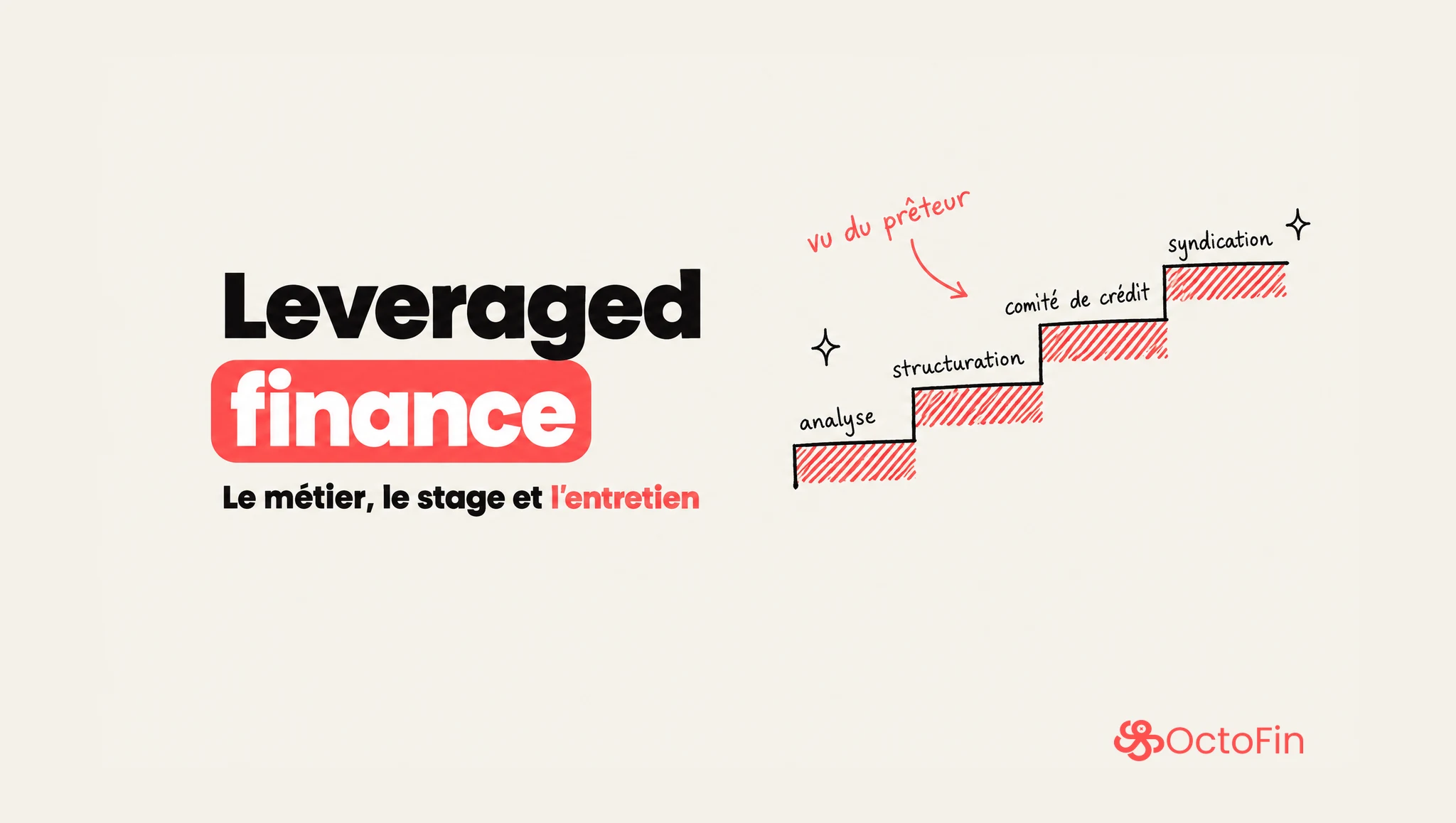
Leveraged finance (LevFin) is debt financing for leveraged buyouts (LBOs) run by private equity funds, and more broadly for companies that already carry a lot of debt: a bank team analyzes the borrower, structures the debt, gets it approved by the credit committee, then holds it or syndicates it. Below: the job from the lender's side, the ECB's thresholds (4 and 6 times EBITDA), a worked example of leverage, debt capacity and covenants, the European market, the internship and the interview, from dated sources and postings.
A fund wants to buy a services company that generates €30m of EBITDA, and it asks a bank to lend 4.5 times that amount to pay for the deal. Before saying yes, the bank asks three questions. Can the company pay the interest and repay the loan? What happens if earnings fall? And how much of the loan does the bank want to keep? Answering those three questions is what leveraged finance is about.
This page is for students who are discovering LevFin or preparing for an internship, in Paris, London or elsewhere in Europe, and it takes the lender's point of view. The rules come from the European Central Bank (ECB), which supervises the largest euro-area banks; the market figures from the reports of AFME (the Association for Financial Markets in Europe); and the facts about teams from bank pages and internship postings, read on October 28, 2026 and rechecked on November 16, 2026. A posting can come down, but what it says about a profile stays a concrete benchmark. Amounts are in euros, as in the sources.
What is leveraged finance?
Inside a bank, the Leveraged Finance department provides the debt for LBOs, and its clients are private equity funds, French or international: that is the definition in Société Générale's glossary. Crédit Agricole CIB widens the scope to companies with no sponsor that are not rated investment grade, and puts both leveraged loans and high yield bonds, sold on the capital markets, under the same roof.
Wall Street Prep's guide to leveraged finance (updated May 10, 2023) draws the line by credit rating. Investment-grade companies (BBB/Baa or better) borrow through traditional bank loans and the bank's Debt Capital Markets (DCM) group; speculative-grade companies, rated below that, are leveraged finance clients, for LBOs, acquisitions, recapitalizations and refinancings.
The private equity fund puts up the equity in an LBO, leveraged finance part of the debt: the first is after a return, the second wants to be repaid. The LBO is the deal; leveraged finance is one of the jobs that funds it. Société Générale adds that banks usually have two departments, Large Cap for big deals and Small & Mid Cap for the rest, because clients, lenders and structuring change with size.
The products: leveraged loans, high yield bonds, private credit
| Product | What it is | Source |
|---|---|---|
| Leveraged loan | A loan to a speculative-grade borrower: secured, floating-rate, arranged privately, and senior in the capital structure | Wall Street Prep |
| High yield bond | A bond from a speculative-grade issuer: fixed coupon, usually unsecured, publicly registered in the US, though often first placed privately under Rule 144A, junior to the loans, with call protection | Wall Street Prep |
| Direct lending (private credit) | A loan made mostly by a debt fund or another non-bank lender (Octus's figures also count banks' direct lending arms) | AFME |
Crédit Agricole CIB says it underwrites across the whole structure: senior secured, second lien, mezzanine and PIK. The ranking of each debt, how it is repaid and its relative cost are set out in question 22 of our M&A interview questions with answers; who brings the debt and the equity into a deal is shown in the LBO structure table of our page LBO: definition and worked example.
What a leveraged finance team does
The seven steps
From the first contact with the fund to the last repayment, the work follows seven steps. The pages and postings quoted were all read on October 28, 2026.
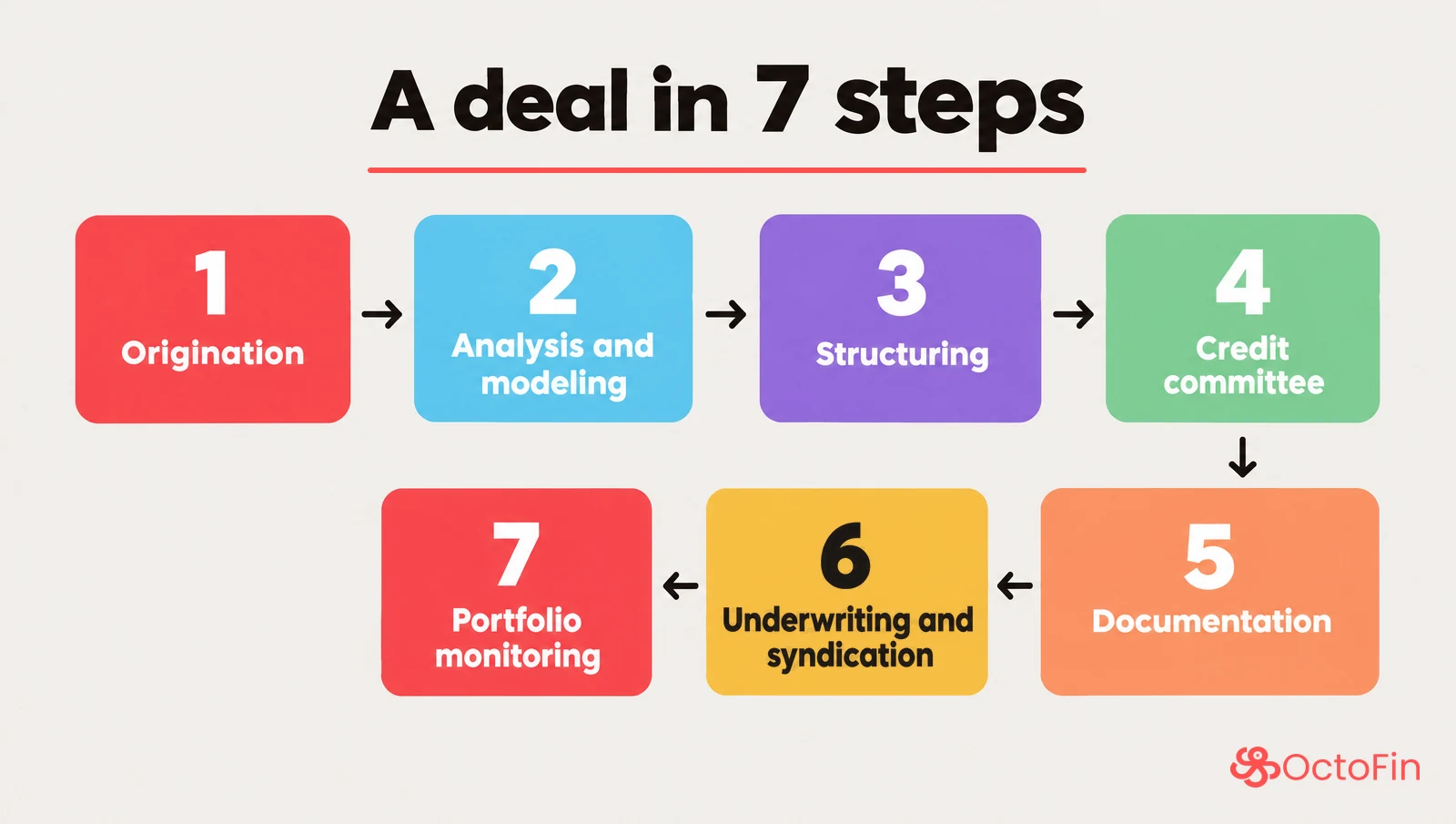
| Step | What the team does | Who describes it |
|---|---|---|
| Origination | Find deals: pitches to funds for a new LBO, a refinancing or a dividend recap | SMBC, HSBC; at Crédit Agricole CIB, the LevFin and TMT teams “originate, structure and execute” |
| Analysis and modeling | Study the company (market, positioning, strategy, outlook) and model its cash flows, in a base case and a downside case | Société Générale, SMBC, HSBC |
| Structuring | Choose the debt instruments, their amounts and their terms | Société Générale; Crédit Agricole CIB (senior secured, second lien, mezzanine, PIK); SMBC (senior, unitranche, second lien) |
| Credit committee | Present the deal to the risk department: a credit application or credit paper, then the committee | Société Générale, SMBC (credit applications written in English), HSBC (credit papers) |
| Documentation | Negotiate the loan agreement with the client, with the lawyers | Société Générale |
| Underwriting and syndication | Keep the whole loan on the balance sheet, or sell part of it to other banks (syndication) or to investors, through the trading floor | Société Générale; SMBC (with the Capital Markets team); HSBC |
| Portfolio monitoring | Reporting, annual reviews, the borrower's requests over the life of the loan | Crédit Agricole CIB (Portfolio Management team), HSBC |
The share of the loan the bank keeps after syndication is its “final take”, in the ECB's words.
A typical day, according to the postings
Internship postings say what a junior actually does. At SMBC, the intern writes credit applications in English, attends the credit committee, runs Excel models (balance sheet, income statement, cash flow, base case and downside case) and prepares pitches. At Crédit Agricole CIB, the Portfolio Management team tracks borrowers' reporting, takes part in lender presentations and prepares the annual reviews of each loan. In an HSBC posting published on Wizbii on November 17, 2017 and still displayed on November 16, 2026, the intern joins client meetings, including bank meetings, and deals with funds, lawyers, audit firms, debt and mezzanine funds and other banks' LevFin teams.
The Société Générale analyst interviewed by Training You, a French interview-prep site (2022), describes how a deal starts: read the due diligence reports and the information memorandum, meet the strategy consultants, the M&A advisers and sometimes the lawyers, then write the memo for the credit committee. For the whole life of the loan, her team handles the borrower's requests, such as an add-on (extra financing) or a waiver (a one-off exemption from a clause in the loan agreement).
On hours, the two accounts we read each describe one team, at one date (2016 and 2022): we draw no rule from them. Ask the analysts you meet.
How the ECB defines a leveraged transaction
Wall Street Prep, quoted above, draws the line by credit rating. For a significant bank in the euro area, the definition that counts is its supervisor's. In May 2017, the ECB published its “Guidance on leveraged transactions”. It applies to the significant banks it supervises directly, with proportionality, and the ECB presents it as its “supervisory expectations”. It took effect six months after publication.
The 2017 rules in one table
| Rule | What the ECB says | What it means for the lender |
|---|---|---|
| The definition | A transaction is leveraged if it meets at least one condition: after the financing, total debt is more than 4.0 times EBITDA; or the borrower is owned by one or more financial sponsors, meaning they control it or own more than 50% of its equity | An LBO where the fund owns more than 50% of the borrower is a leveraged transaction, even below 4.0x, unless it is excluded |
| Total debt | All committed debt, drawn or undrawn, plus any additional debt the loan agreement permits; only undrawn committed liquidity facilities, as defined under Basel III, are left out. Cash is not netted. The test uses pro forma accounts, after the deal | The ECB's leverage is gross leverage |
| EBITDA | Any adjustment to EBITDA must be justified and reviewed by a function independent of the front office | An overly optimistic “adjusted” EBITDA does not go through as is |
| Exclusions | Loans to individuals, banks, investment firms, the public sector and the financial sector; exposures below €5m; SMEs, unless owned by a sponsor; specialized lending (project, real estate, asset and commodity finance); trade finance; investment-grade borrowers (the guidance writes “BBB (S&P)/BBB- (Fitch)/Baa3 (Moody's) or above”) | An acquisition loan to a large investment-grade group is out |
| Above 6.0 times | Syndicating a deal with total debt above 6.0 times EBITDA at origination should remain exceptional, and any exception must be justified; for most industries, the ECB writes, that level raises concerns | Not a ban, but an exception to defend |
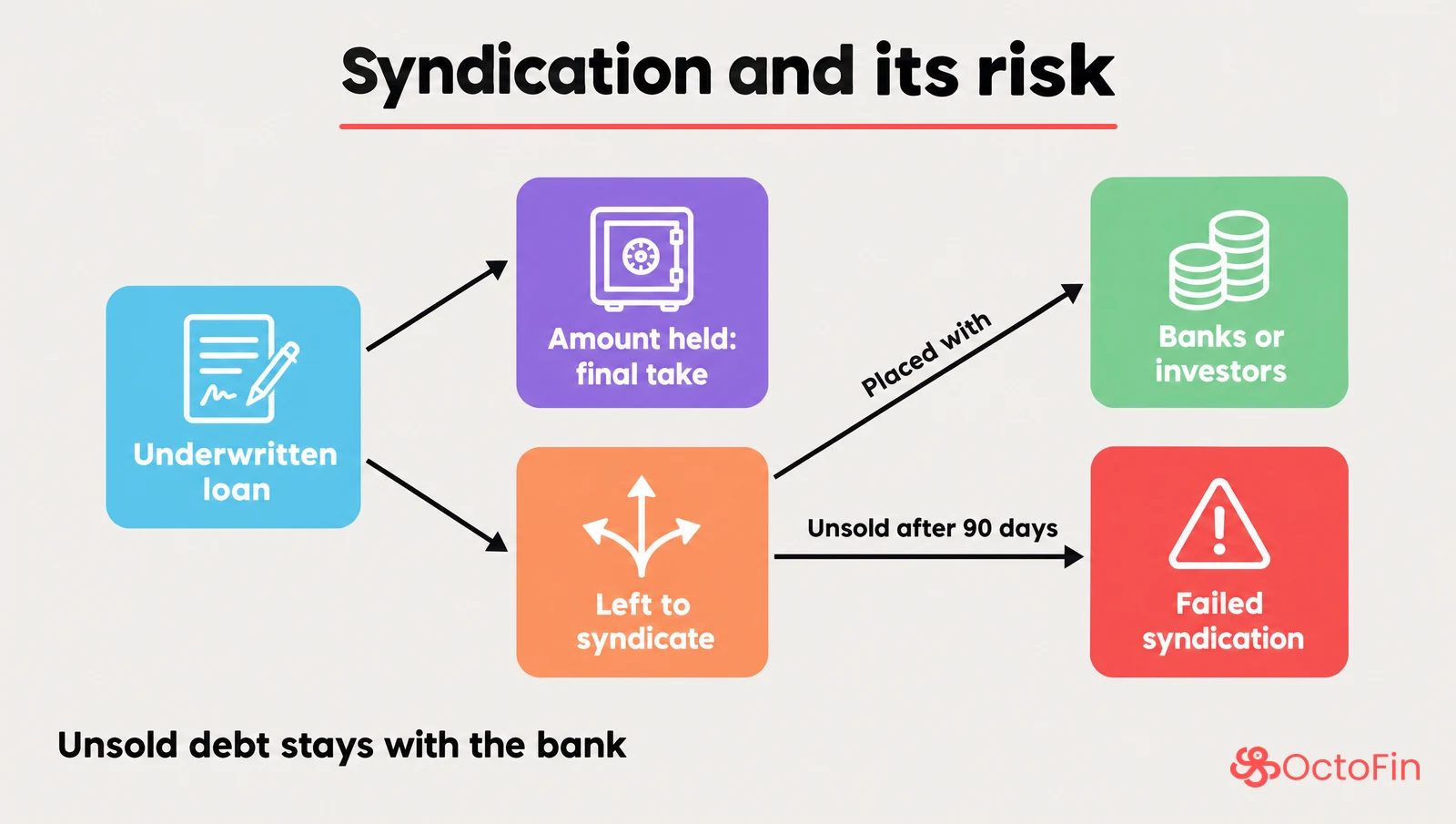
| Failed syndication | A deal not syndicated within 90 days of the commitment date; the ECB calls these “hung transactions” | The bank must have planned how it holds them, accounts for them and covers them with capital |
| Debt capacity | It is adequate if the borrower can repay all of its senior secured debt, or at least 50% of its total debt, within 5 to 7 years. The analysis rests on a base case and a stress case | This is the test in the worked example below |
| Covenants | The bank's systems must flag the absence of covenants, the absence of financial covenants or large headroom in those covenants, and track every breach | A covenant set too loose no longer protects the lender |
| Approval | Every transaction that carries credit, underwriting or syndication risk goes first through an independent risk function | At Société Générale, the team presents the deal to the risk department |
| Monitoring | The portfolio the bank keeps (the “hold book”) is reviewed at least once a year; the breach of a material financial covenant, or a refinancing at higher leverage, triggers an impairment test | The work goes on after closing |
What the ECB has found since
In March 2022, the ECB wrote to the management of significant banks that, despite progress in applying the guidance, material weaknesses remained. The figures in its letter of March 28, 2022 cover specific scopes.
- The 28 banks in its dashboard (the “Leveraged Finance Dashboard”, filled in every quarter): between Q1 2018 and Q3 2021, the leveraged loans held on their balance sheets rose from under €300bn to about €500bn, an increase of about 80% according to the ECB, and from about 40% to almost 60% of their CET1 capital.
- Origination by significant banks, in aggregate: deals above 6.0 times EBITDA (highly leveraged transactions, or HLTs) made up about half of volumes in 2019 and 2020, and more than 60% in the first two quarters of 2021; LBOs and M&A deals, more than half of origination in the first half of 2021.
- Documentation: in the first half of 2021, covenant-lite or covenant-free loans were more than 60% of the leveraged loan volume these banks originated, against about 50% in previous years.
The ECB made leveraged finance a supervisory priority for 2022 to 2024, warning that it could raise the capital requirements of banks that did not fix their weaknesses. In its supervision newsletter of August 14, 2024, it says it applied dedicated capital requirements to banks that are highly exposed or whose risk management is not robust enough. It puts the rise in European banks' leveraged finance exposures at 59% between Q1 2018 and Q1 2023, and describes a review launched in 2023: on-site inspections of the credit files of 12 banks, with about three times as many files as a usual inspection.
What these texts are, and what they are not
- Banking supervision rules, not market statistics. The 4.0x and 6.0x thresholds are definitions and warning signs, not average levels. The 2022 figures describe significant banks between 2018 and 2021 (28 of them for exposures), not the whole market today.
- Rules for banks in the euro area. Their scope is the significant banks the ECB supervises: a private debt fund is not a bank, and the guidance does not cover it. The guidance asks each of these banks for a single definition covering all its business units and geographical areas, so it also covers their London or New York desks; a British or American bank answers to its own supervisor, whose rules this page does not cover.
- Interview vocabulary. If you quote 4 or 6 times EBITDA, say where the numbers come from and that they apply to total debt, with no cash netted.
Worked example: a credit file from the lender's side
The example is made up, with round numbers. It walks through the questions a LevFin team asks before the credit committee. Everything was calculated by script, with no intermediate rounding; amounts are in € millions.
The assumptions.
- A fund buys 100% of a French services company. Last-twelve-months EBITDA, pro forma for the deal: 30.
- Depreciation and amortization: 6, so operating profit (EBIT) of 24. Capex: 3 a year, for a services business that invests little. Working capital doesn't move.
- Tax: 25% of EBIT, ignoring the deduction of interest. That's prudent: if all of case A's interest (10.8 a year) were deductible, tax would fall by 0.25 × 10.8 = 2.7; real cash flow is therefore higher, by 2.7 a year at most.
- The company's cash after the deal: 15.
- Debt: 135 in case A, 195 in case B, all senior secured, at an assumed average rate of 8% a year. Repaying all the senior secured debt then means repaying everything: the ECB's 50% branch is the one that matters.
- The lender's base case assumes no growth: EBITDA stays at 30.
- The bank arranges the deal alone; it wants to hold 20 and syndicate the rest.
- The loan agreement has a net leverage covenant: net debt must not exceed 5.0 times EBITDA.
Step 1: leverage, gross and net
| Case A | Case B | |
|---|---|---|
| Total debt | 135 | 195 |
| Gross leverage (total debt / EBITDA) | 135 / 30 = 4.5x | 195 / 30 = 6.5x |
| Net debt (debt − cash) | 135 − 15 = 120 | 195 − 15 = 180 |
| Net leverage (net debt / EBITDA) | 120 / 30 = 4.0x | 180 / 30 = 6.0x |
This is the trap. Case A can be pitched as debt of “4.0 times EBITDA”: true, net of cash. For the ECB, which doesn't net cash, it's 4.5 times, above the 4.0 threshold. Case B, “6.0 times” net, is at 6.5 times on total debt: beyond the level where syndication should remain exceptional. And in both cases, the deal is a leveraged transaction under the ECB definition for another reason anyway: a fund owns more than 50% of the company.
Step 2: debt capacity, case A
The lender starts from the cash the company generates before paying its debt: cash flow available for debt service.
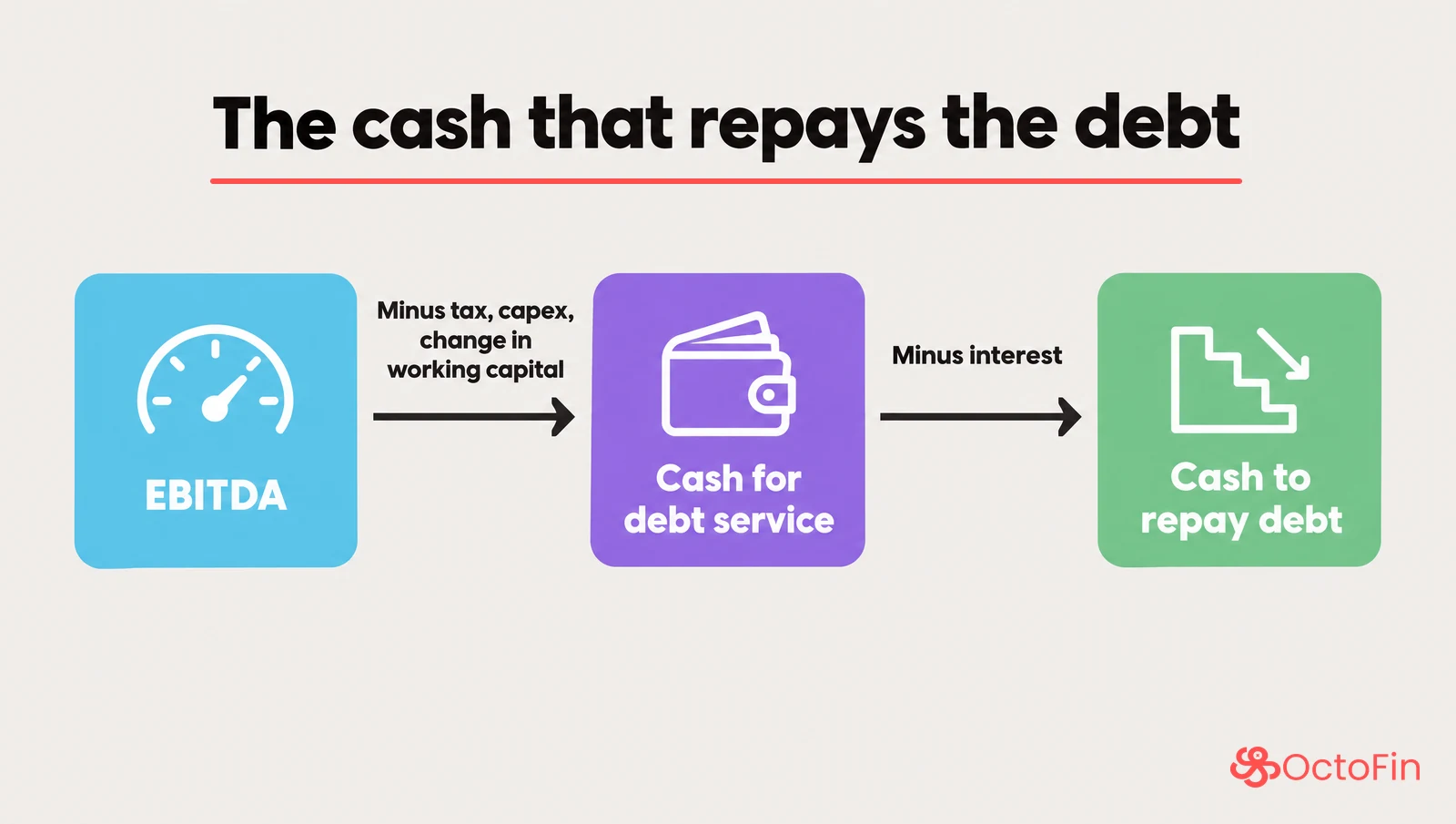
| Line | Calculation | Amount |
|---|---|---|
| EBITDA | 30 | |
| − Tax | 0.25 × 24 = 6 | −6 |
| − Capex | −3 | |
| − Change in working capital | 0 | |
| = Cash flow available for debt service | 30 − 6 − 3 = 21 | 21 |
| − Interest | 0.08 × 135 = 10.8 | −10.8 |
| = Cash available to repay debt, per year | 21 − 10.8 = 10.2 | 10.2 |
The ECB test: repay at least half of total debt within 5 to 7 years, that is 135 / 2 = 67.5.
- In 5 years: 5 × 10.2 = 51.0, or 51.0 / 135 ≈ 37.8% of the debt.
- In 7 years: 7 × 10.2 = 71.4, or 71.4 / 135 ≈ 52.9% of the debt.
- Half is repaid after 67.5 / 10.2 ≈ 6.6 years.
Case A passes, within the 5-to-7-year window, but not by year 5. This calculation keeps year-one interest: that's prudent, because interest falls as the debt is repaid. If all the cash goes to repaying debt every year (a cash sweep), the script gives 44.3% of the debt repaid after 5 years and 67.4% after 7 years: half is reached during year 6. The guidance sets no calculation method: it asks for a base case, a stress case and a review by an independent risk function.
Step 3: the same test, case B
With 195 of debt, interest rises to 0.08 × 195 = 15.6, and cash available to repay falls to 21 − 15.6 = 5.4 a year.
- In 7 years: 7 × 5.4 = 37.8, or 37.8 / 195 ≈ 19.4% of the debt, far from 50%.
- Half, 195 / 2 = 97.5, would take 97.5 / 5.4 ≈ 18.1 years at constant interest. With a cash sweep, the script gives 24.7% repaid after 7 years, and half only in year 12.
The extra debt, 195 − 135 = 60, costs 0.08 × 60 = 4.8 of interest a year: exactly what's missing from repayment, 10.2 − 5.4 = 4.8. At 6.5x, the company pays its interest but deleverages slowly.
Step 4: the covenant and its headroom, case A
The covenant caps net debt at 5.0 times EBITDA. The level, the definitions of net debt and EBITDA and the test dates are those of the loan agreement: here, they are assumptions. At closing, net leverage is 4.0x. How far can EBITDA fall, with net debt unchanged, before a breach?
- The EBITDA floor: 120 / 5.0 = 24.
- The possible decline: 30 − 24 = 6, or 6 / 30 = 20%.
- The shortcut: 4.0 / 5.0 = 0.8, so headroom of 1 − 0.8 = 0.2, or 20%.
Headroom of 20% gives the borrower room to absorb a drop in earnings without breaching its loan agreement. The lender doesn't want headroom that's too wide: the ECB lists large headroom among a covenant's weaknesses and asks banks to flag it, like the absence of covenants. In the Octus classification used by AFME, a “traditional” loan has 3 or 4 financial maintenance covenants, tested regularly; a “cov-lite” loan has a single one, on leverage, attached to the revolving credit facility and only triggered in certain cases (“springing”).
Step 5: syndication and the 90 days
The bank underwrote all 135 of case A alone and wants to hold 20: it has to place 135 − 20 = 115 with other banks or investors. If, 90 days after the commitment date, it has placed only 70, it is left with 115 − 70 = 45 unsold. It then holds 20 + 45 = 65, or 65 / 20 = 3.25 times what it wanted to keep. For the ECB, that's a failed syndication.
The summary for the credit committee
Out loud, in committee or in an interview, it sounds like this:
“Case A: €135m of debt against €30m of EBITDA, so 4.5 times on total debt and 4.0 times net of cash. It's a leveraged transaction under the ECB definition, both because of the leverage and because the fund owns the company. In our base case, with no growth, the company generates €10.2m a year after interest: it repays half its debt in 6.6 years at constant interest, during year 6 with a cash sweep, so within the 5-to-7-year window. The 5.0x covenant leaves 20% of EBITDA headroom. At €195m, or 6.5 times, the company would repay only about 19% of its debt in 7 years: that deal, we couldn't defend.”
The follow-up questions
“What about a stress case, with EBITDA down 20%?” EBITDA falls to 30 × 0.8 = 24. Tax: 24 − 6 = 18, and 0.25 × 18 = 4.5. Cash flow available for debt service: 24 − 4.5 − 3 = 16.5; after interest, 16.5 − 10.8 = 5.7 a year. In 7 years: 7 × 5.7 = 39.9, or 39.9 / 135 ≈ 29.6% of the debt, and 37.7% with a cash sweep: the test fails. Net leverage rises to 120 / 24 = 5.0x: right at the covenant limit.
“And if EBITDA falls 25%?” It drops to 30 × 0.75 = 22.5, and net leverage to 120 / 22.5 ≈ 5.33x: the covenant is breached. For the ECB, the breach of a material financial covenant triggers, at the bank, an analysis of the borrower's difficulties and an impairment test. The borrower, for its part, can ask its lenders for a waiver: one of the requests portfolio monitoring handles, according to the analyst interviewed by Training You (2022).
“What if the agreement adds a committed, undrawn capex facility of 15?” For the ECB, total debt includes committed debt, drawn or not: 135 + 15 = 150, and 150 / 30 = 5.0x. The covenant's net leverage, calculated here on drawn debt, stays at 4.0x as long as the facility isn't used: the definition in the agreement decides.
“What's the most debt you can raise without going above 4.0x?” 4 × 30 = 120. But even at 120, the deal would still be a leveraged transaction under the ECB definition: the company is owned by a fund.
This example only looks at the lender. For the same kind of deal from the fund's side, with the equity return, the MOIC and the IRR, go to the paper LBO solved step by step or the mini LBO in our private equity careers guide.
The European leveraged finance market in numbers
Every quarter, AFME publishes a report on leveraged debt in Europe, which it splits into three markets: leveraged loans, direct lending (loans made mostly by debt funds or other non-bank lenders; Octus's figures also count banks' direct lending arms) and high yield bonds. We read the latest two, both the summary page and the PDF report: the Q1 2026 report, published on June 3, 2026, and the Q2 2026 report, published on September 29, 2026. Where the summary page and the PDF differ, we follow the PDF.
| Issuance, € billions | Q1 2026, first estimate (report of June 3, 2026) | Q1 2026, revised (report of September 29, 2026) | Q2 2026 (report of September 29, 2026) |
|---|---|---|---|
| Leveraged loans | 81.8 | 100.9 | 96.1 |
| Direct lending | 26.4 | 27.4 | 20.5 |
| High yield | 21.8 | 22.4 | 50.4 |
| Total | 130.0 | 150.7 | 167.0 |
Source: AFME, chart 1.1 of each report (Octus and Dealogic data).
Q1 2026 was revised up by 150.7 − 130.0 = 20.7 billion euros between the two reports, mostly in leveraged loans (100.9 − 81.8 = 19.1). AFME notes that its figures use the data available in April 2026 for the first report and in July 2026 for the second. In an interview, quote a market figure with the date of the report it comes from.
What the debt is used for
The Q1 2026 report breaks down the use of proceeds, and the three markets don't serve the same needs.
| Q1 2026 | Leveraged loans | High yield | Direct lending |
|---|---|---|---|
| Refinancing | 78%, plus 4% debt repayment | 50% (refinancing and debt repayment) | 24% |
| Acquisitions | 8% | 9% | 26% (bolt-on acquisitions) |
| LBOs | 5% (LBO/MBO) | no LBO category in the chart | 29% (LBOs, including secondary buyouts and take-privates: “LBO/SBO/P2P”) |
| Other | 3% capital expenditures | 36% general corporate purposes | 17% capex and growth |
Source: AFME, Q1 2026 report, charts 1.2 to 1.4 (Dealogic for leveraged loans and high yield, Octus for direct lending).
In the first quarter of 2026, European leveraged loans were therefore mostly used to refinance existing debt, while LBOs and acquisitions made up more than half of direct lending. Over the first half of 2026, the next report confirms the split: 71% refinancing and 5% repayment for leveraged loans; in direct lending, 30.8% acquisitions, 29% LBOs and 20.9% refinancing.
Two more data points from the Q2 2026 report:
- France accounted for 21.3% of European direct lending origination in Q2 2026, second behind the UK and Ireland (29.5%).
- Direct lending leverage: AFME describes Europe as relatively conservative, with leverage capped below 8 times EBITDA, most often between 2 and 6 times.
On the French side, the Banque de France notes in its June 2026 Financial Stability Review that private credit went through a period of turbulence in early 2026, and that the French banking sector has little exposure to it. None of these figures says how many analysts or interns the teams hire.
Where to work in leveraged finance in Paris
Here are the employers whose page or posting we read, in no order of merit: no ranking was checked for this page, and we don't give a number of teams in Paris.
| Type of employer | Employer | What its page or posting says | Source |
|---|---|---|---|
| French bank | Société Générale | A Leveraged Finance department that provides LBO financing to French or international funds; usually a Large Cap and a Small & Mid Cap department | Glossary, read on October 28, 2026 |
| French bank | Crédit Agricole CIB | A global business, with teams in Paris, London, Milan, Madrid, Frankfurt, Stockholm, Hong Kong, Sydney and New York; “+73 experts” and 9 offices; a Portfolio Management team in Montrouge, just outside Paris | Leveraged Finance page and posting, read on October 28, 2026 |
| Foreign bank | SMBC | A Leveraged Finance Origination team in Paris; about 60 LevFin professionals across Frankfurt, London and Paris; a Paris branch of 150 people | Posting, read on October 28, 2026 and rechecked on November 16, 2026 |
| Foreign bank | HSBC | In a posting published in 2017: the Leveraged Finance MMFS team, in the Commercial Banking division, 12 people in Paris, who originate, structure and syndicate LBO financings | Posting published on Wizbii on November 17, 2017, read on November 16, 2026 |
| Debt advisory | Lincoln International | A Debt Advisory team in Paris that advises funds, companies and their management on their financing | Posting, read on October 28, 2026 |
| Private debt fund | — | The direct lending lenders: funds or other non-bank entities, per AFME's definition | Q1 2026 report |
BNP Paribas isn't in the table: we couldn't read a leveraged finance internship posting on its careers site on October 28, 2026. To search yourself, also type the titles used in these postings: “financement LBO” (HSBC, in French), “debt advisory” (Lincoln International), “portfolio management” (Crédit Agricole CIB), and “leverage finance”, without the “d”, as SMBC writes it.
Leveraged finance vs acquisition finance, DCM and private credit
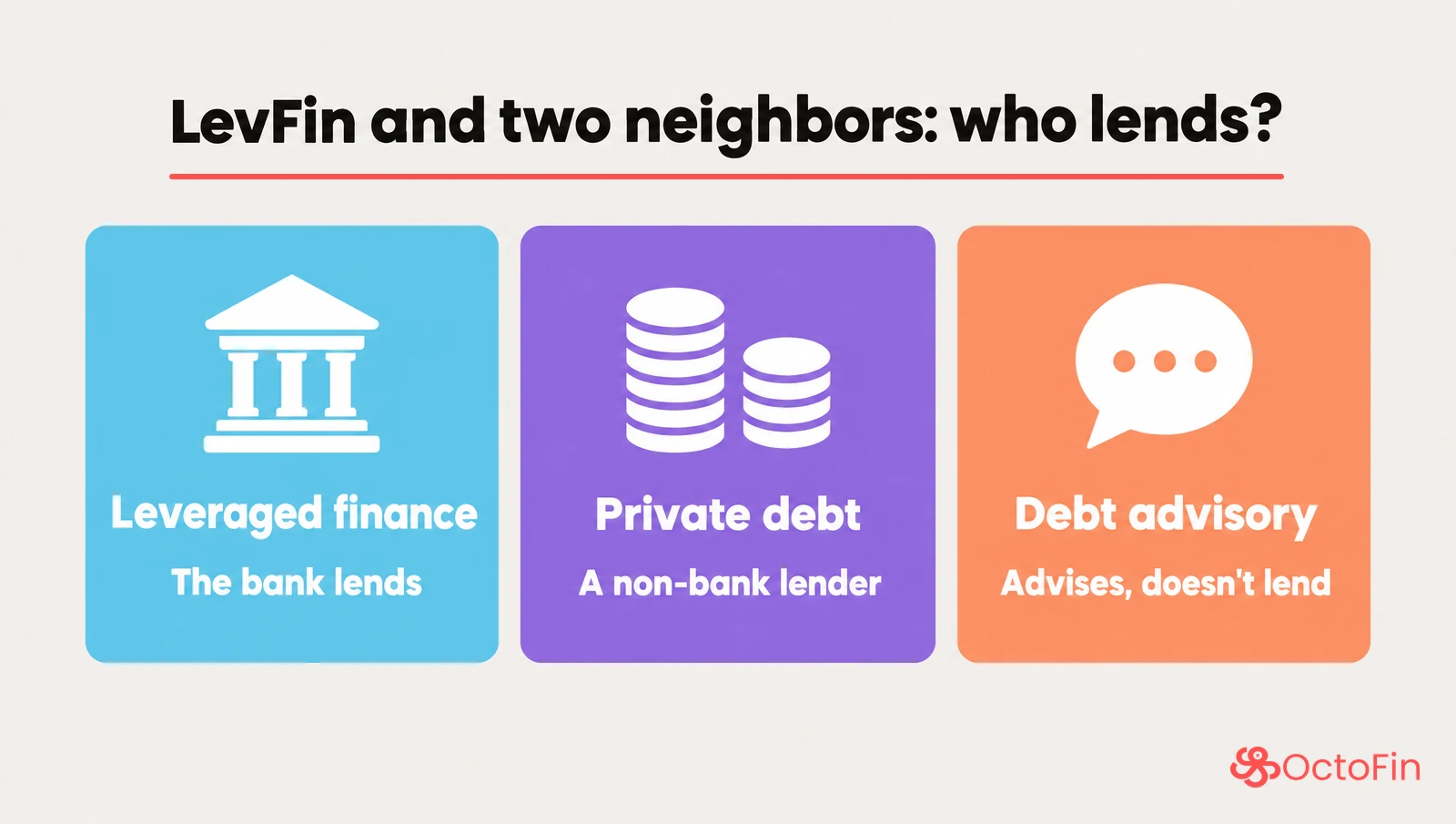
LevFin has several neighbors, which sometimes work on the same deal. Here is what separates them, according to this page's sources.
| Job | Who it serves | What sets it apart from LevFin | Source |
|---|---|---|---|
| Leveraged finance (bank) | Private equity funds, and companies that aren't investment grade | The bank lends, underwrites, syndicates and monitors the loan; in the euro area, its rules for significant banks are the ECB's | Société Générale, Crédit Agricole CIB, ECB |
| Acquisition finance | Companies buying other companies | For the analyst interviewed by Training You (2022), it works mostly with large listed investment-grade groups, whereas LevFin works almost exclusively with funds. An investment-grade borrower is excluded from the ECB definition | Training You (2022), ECB |
| Debt capital markets (DCM) | Investment-grade issuers | Loan syndication and bond underwriting for companies rated BBB/Baa or better, whose low-rate loans come from the corporate banking division; LevFin also syndicates loans and underwrites bonds, but for speculative-grade credits | Wall Street Prep |
| Private debt (direct lending) | Funds and companies that borrow | The lender is most often a debt fund or another non-bank entity, which the ECB guidance doesn't cover (Octus's data, used by AFME, also count banks' direct lending arms) | AFME, ECB |
| Debt advisory | The borrower: the fund, the company, its management | It doesn't lend: it advises on the structure, prepares the documents for lenders, picks the lenders to approach and negotiates the terms | Lincoln International |
| Capital markets and high yield | Bond issuers | The debt is placed with investors on the market. At Crédit Agricole CIB, LevFin also provides bridge financing ahead of a high yield issue; at SMBC, the LevFin intern helps the Capital Markets team when a deal is underwritten and syndicated | Crédit Agricole CIB, SMBC |
| M&A | The seller or the buyer | It advises on the deal itself, from pitch to closing: see our M&A analyst guide | Postings in the M&A guide |
| Transaction services | The buyer, the seller or the lenders | It checks the target's numbers (normalized EBITDA, net debt) in a due diligence report the lender reads: see our transaction services guide | Firm pages in the TS guide |
To place all these jobs inside an investment bank, our page investment banking: definition and divisions covers them one by one.
The leveraged finance internship
Four postings show what is expected of an intern: three put online in October 2026 (Crédit Agricole CIB, SMBC, Lincoln International) and one from HSBC, published on Wizbii on November 17, 2017 and still displayed in November 2026. They don't say what every bank asks for, or every team within the same bank.
| Employer and role | Location, start, length | What the intern does | Profile required |
|---|---|---|---|
| Crédit Agricole CIB, Leveraged Finance & Telecom – Portfolio Management, ref. 115042 (eFinancialCareers and Welcome to the Jungle) | Montrouge, just outside Paris; starts January 4, 2027; 6 months | Tracking reporting, lender presentations, annual reviews of each loan, analysis of new deals in the portfolio, support in putting financings in place | Master's level (Bac +5 / M2), business or engineering school; 0 to 2 years' experience; financial analysis, Microsoft Office, fluent French and English |
| SMBC, Leverage Finance Intern Associate, ref. 20351 (eFinancialCareers) | Paris; January 2027; 6 months | Originating and executing financings (loans and bonds) for leveraged clients in France; credit applications in English and credit committee; Excel models in a base case and a downside case; pitches (new LBO, refinancing, dividend recap); support to the Capital Markets team | Final-year, gap-year or second-year students; a previous internship, ideally in LBOs (bank, CLO, private equity) or in banking, is welcome; excellent English and French |
| HSBC, Stage Leveraged Finance / Financement LBO (Wizbii, posting published on November 17, 2017) | Paris; start and length not stated | Credit and industry analysis, structuring, due diligence, credit papers, models (structures, cash flow, IRR), pitches, bank meetings, LBO portfolio management | Fourth- or fifth-year students on a gap year or in their final year, preferably from a business school (Grande École program), an engineering school with a finance option, a Sciences Po (IEP) or a specialized graduate program; financial analysis and modeling; the main debt instruments; French and English required; prior experience in investment banking, private equity, M&A, transaction services or strategy consulting “would be a plus” |
| Lincoln International, Debt Advisory Internship (LinkedIn) | Paris; March 2027; length not stated | Credit and debt analysis (leverage, cash flow, covenants), documents for lenders, lender research, coordinating non-disclosure agreements, due diligence, through to closing | At least six months of prior internship in debt advisory, leveraged finance, M&A, private equity or transaction services; English and French; no visa sponsorship |
Two clarifications. eFinancialCareers files the SMBC posting under “CDI” (a permanent contract), but its text describes a 6-month analyst internship starting in January 2027: we follow the text. And the Crédit Agricole CIB posting is in Montrouge, in the Hauts-de-Seine département, not in Paris proper. A Société Générale Leveraged Finance internship posting on its careers site was no longer online on October 28, 2026: it isn't in the table. On November 16, 2026, the Crédit Agricole CIB posting was no longer online; the SMBC posting (on SMBC's careers site) and the Lincoln International posting (on LinkedIn) still were.
What these rows mean for you. In three postings out of four, no prior experience is required: Crédit Agricole CIB writes “0 - 2 ans” (0 to 2 years), SMBC welcomes a previous internship without requiring one, and HSBC counts it as a plus. Lincoln International's debt advisory team, on the other hand, requires six months of internship first. If you're an international student, note two things: all four postings ask for French as well as English, and Lincoln International writes that it doesn't hire candidates who need visa sponsorship. Financial analysis comes up in three of them: that's what the worked example above makes you practice.
The postings that give a date start in January or March 2027, for 6 months when the length is stated: outside the banks' summer season, these are off-cycle internships. Their rules in France (legal length, internship agreement, minimum stipend) and the application calendar are in our page on the off-cycle internship in investment banking.
The leveraged finance interview
What the postings say
None of the four postings describes the recruiting steps. They do say which skills they want: financial analysis (Crédit Agricole CIB, SMBC, HSBC), modeling and debt instruments (HSBC), writing in English (SMBC), credit, leverage and covenant analysis (Lincoln International). Be ready to talk about them with a worked example.
The process described by a Société Générale analyst (Training You, 2022)
In an interview published by Training You on November 30, 2022, an analyst in Société Générale CIB's Large Cap team describes her own recruitment, for a role she found on LinkedIn. It's one account, for one team, at one date.
| Step | What she describes |
|---|---|
| 1 and 2 | Two one-hour interviews, each with three team members |
| 3 | A two-hour fit interview with the head of the team |
| 4 | A debrief with HR on online tests taken at home: logic, English, personality |
On the technical side, she lists three exercises: an LBO case (income statement, cash flows, net debt schedule, leverage calculation), a SWOT analysis of a given company, and an industry the candidate finds attractive for an LBO, to be defended with its risks. On fit, she lists background and internships, the deals the candidate worked on, interest in LBOs and understanding of the job, motivation for the bank, strengths and weaknesses.
The topics AlumnEye listed (2016)
In 2016, the analyst interviewed by AlumnEye, another French interview-prep site, listed the basics to know: how the balance sheet, income statement and cash flow statement link together; the company's metrics (EBITDA margin, cash flow, working capital, capex); the deal's metrics (leverage ratio, minimum equity, covenants); and how the business works in each industry. She also stressed the expected mindset: the lender's, who wants to limit risk to be repaid, not to maximize a return.
How to prepare
- Leverage and debt capacity. Redo this page's example without looking: gross and net leverage, the 50% test, covenant headroom. That's the leverage calculation in the case Training You describes, and the leverage ratio and covenants AlumnEye lists.
- The LBO case. Practice on paper, with no spreadsheet, using our paper LBO solved step by step.
- The debt in an LBO. “What types of debt are used in an LBO?” is answered, with the ranking of each one, in our M&A interview questions.
- “Why leveraged finance rather than M&A or private equity?” The interviewer checks that you know which side you'll be on: the lender's, which judges an ability to repay, not a price or a return. The table of neighboring jobs above gives you the differences; your reasons have to come from your own background.
Leveraged finance exit opportunities
None of the sources read for this page says which paths are the most common. Here are the ones the two accounts and one posting mention, in no order.
- Staying in the job: the Société Générale analyst interviewed by Training You (2022) mentions LevFin at another bank.
- From intern to analyst: Lincoln International mentions, in its posting, the possibility of joining the team as an analyst after the internship (posting read on October 28, 2026).
- Neighboring debt jobs: private debt, debt advisory and restructuring, according to the same analyst (2022); debt and mezzanine funds, and hedge funds, according to the analyst interviewed by AlumnEye (2016).
- M&A and private equity: both mentioned by Training You (2022); AlumnEye (2016) mentions private equity.
- Corporate: a finance role in a company (Training You, 2022), “corporate” (AlumnEye, 2016).
The analyst interviewed by AlumnEye said in 2016 that people stay longer in LevFin than in M&A. That's one analyst's view, ten years ago: check it with today's analysts.
Frequently asked questions
What does LevFin mean?
LevFin is short for leveraged finance: lending to companies that carry a lot of debt, mostly to fund the LBOs of private equity funds. A leveraged loan is a loan to such a company; a leveraged transaction, under the ECB definition, means total debt above 4.0 times EBITDA or a borrower owned by a fund, subject to exclusions.
What is the difference between leveraged finance and acquisition finance?
Both fund acquisitions, but not for the same borrowers. LevFin mostly funds funds' LBOs and companies that aren't investment grade (Crédit Agricole CIB). Acquisition finance, according to the analyst interviewed by Training You in 2022, works mostly with large listed investment-grade groups. The ECB draws the same line: an investment-grade borrower is excluded from its definition of leveraged transactions.
What is the difference between leveraged finance and DCM?
The credit rating. Wall Street Prep places investment-grade companies (BBB/Baa or better) with the Debt Capital Markets group, and speculative-grade borrowers with leveraged finance. Both teams can syndicate loans and underwrite bonds; LevFin does it for riskier, higher-yielding debt.
How do you calculate leverage, gross or net?
Gross leverage divides total debt by EBITDA; net leverage subtracts cash first. In this page's example: 135 / 30 = 4.5x gross; net, 135 − 15 = 120, and 120 / 30 = 4.0x. The ECB, for its definition, uses gross leverage and counts all committed debt, even undrawn; a covenant follows the definition written in the loan agreement. When you give a leverage figure, always say which one.
Do leveraged finance teams hire interns?
Yes: we found three internship postings put online in October 2026, at Crédit Agricole CIB, SMBC and Lincoln International (debt advisory), and an HSBC posting published in 2017 and still displayed. On November 16, 2026, the Crédit Agricole CIB one was no longer online. The accounts we read describe limited hiring: the analyst interviewed by Training You in 2022 mentions one or two interns in her team, and the one interviewed by AlumnEye in 2016 described a “relatively closed” field. That's two teams, at two dates.
How much does leveraged finance pay?
We don't give a figure: none of the four postings we read states pay, and we found no amount specific to leveraged finance backed by a dated primary source. For internships in France, the legal minimum stipend and the only amount we found in a posting (Barclays, Capital Markets program in Paris, which includes leveraged finance) are in our page on the off-cycle internship in investment banking.
Keep practicing
A leveraged finance interview is prepared by doing: leverage, the LBO case and the debt structure have to come without effort. In OctoFin, the LBO is one of 11 chapters of lessons (57 lessons in all); more than 1,000 practice questions come as flashcards, multiple-choice or open-ended prompts; and more than 1,300 real interview reports show you what banks actually ask. Plans and pricing are on the home page: see pricing. OctoFin doesn't offer one-to-one coaching: for a mock interview with a LevFin banker, a human coach is the better fit.