
Investment Banking Interview Questions: 28 Questions With Spoken Answers, Common Mistakes and Worked Examples
- Investment Banking
- Interviews
Investment banking interview questions fall into three blocks: fit and behavioral, technicals (accounting, valuation, M&A, LBOs) and market questions. Here are 28 classic ones, each with an answer written to be said out loud in 30 to 60 seconds, then the common mistake that costs the most. The math, from a $10 change in depreciation to a mini paper LBO, is worked through step by step in plain text.
How an investment banking interview works
For a summer internship or a full-time analyst role, a recruiting process generally strings together online tests, a first-round interview, several rounds with bankers that mix technicals and fit, and a final round, called a superday in the US and often an assessment center in the UK. Whatever the format, investment banking interview questions come from the same three blocks, and the 28 below are the classics you'll find from one prep guide to the next.
How to use them: read the question, cover the answer, answer out loud with a timer, then compare. The text in quotation marks is what you say; "Common mistake" is the error that costs the most; the numbers in the calculations are examples. A correct answer that takes three minutes is still a miss: the interviewer wants to see that you can structure your thinking.
| Block | Questions | What the interviewer is checking |
|---|---|---|
| Fit and behavioral | 1 to 6 | A clear story, real motivation, self-awareness |
| Accounting and enterprise value | 7 to 11 | That you can link the three statements and bridge enterprise value to equity value |
| Valuation | 12 to 16 | The methods, the DCF, WACC and multiples, and their limits |
| M&A and LBOs | 17 to 23 | Deal logic, and quick math done by hand |
| Market, brainteaser, your questions | 24 to 28 | Curiosity, structured thinking, genuine interest in the job |
Fit and behavioral questions
Strong technicals won't save a weak fit interview. The answers below are structures: fill in the brackets with your own details.
1. Walk me through your resume (or: tell me about yourself)
"I'm a [junior / senior] at [university], majoring in [economics / finance]. What got me into finance was [a concrete trigger]. I then did [experience 1], where I [a specific task and its result], and [experience 2], where I learned [a skill that matters in banking]. Those experiences confirmed that I want to work on transactions, on the advisory side. That's why I'm applying for [the summer analyst program / an analyst role] in your [M&A / industry] group."
In the UK, open with your year and course instead ("I'm in my penultimate year at [university], studying [subject]"); a spring week counts as an experience.
Keep it under a minute: the interviewer will dig into whatever interests them.
Common mistake: reading your resume line by line, from high school to today. The interviewer has it in front of them: they want the thread that connects your choices.
2. Why investment banking?
"For three reasons. First, the learning curve: I want to start my career on live transactions, where I'll learn valuation, modeling and how a deal actually gets done, faster than in any other job I've looked at. I got a first taste of it when [a concrete experience: internship, student investment fund, case competition], and the part I enjoyed most was [a specific task]. Second, the exposure: as an analyst, I'd work across several deals, sectors and clients, alongside senior bankers and executives facing some of their biggest decisions. Third, the way the work gets done: small teams, tight deadlines, a high bar for accuracy. That's where I do my best work, as I saw when [a short example]. I know the job is demanding: I've talked with [two analysts / alumni from my school] about what their weeks really look like, and that confirmed my choice."
Common mistake: money, prestige or "exit opportunities" as your main reason, or a generic "I love finance and fast-paced environments" with nothing to back it up. Every reason needs evidence from your own story, and the answer shouldn't work just as well for consulting.
3. Why not private equity (or consulting)?
"Private equity invests in a handful of companies and owns them for several years. Investment banking advises companies and funds on their transactions: you see more deals and more sectors, and you learn execution end to end, from the model to the negotiation. At the start of my career, that volume and variety is what I'm after. And I like the advisory role: helping a client through a major decision."
For consulting, the same structure works: consultants advise on strategy and operations, bankers on transactions and how to finance them. Say why transactions are what draw you.
Common mistake: presenting banking as a mere stepping stone to private equity, or criticizing the other job. You can have PE in mind; your answer still needs positive reasons to do banking.
4. Why our bank? Where else are you applying?
"Three reasons. Your positioning: you're [a bulge bracket / an elite boutique / a middle-market bank], which for me means [large deals with financing in-house / advice only, in small teams / mid-sized deals and broad exposure]. Your recent deals: I followed [a deal the team advised on], and what caught my attention was [a specific point]. Your people: I spoke with [someone on the team], who told me about [something concrete]. Elsewhere, I'm applying to similar banks: [two or three names of the same type]."
Common mistake: a vague compliment ("a prestigious bank") that works for every bank, or claiming you haven't applied anywhere else. Nobody believes it: the interviewer is checking that your search is consistent.
5. What are your strengths and weaknesses?
"My main strength is [a strength that matters for an analyst, such as reliability under deadlines or attention to detail]. One example: [a short proof, with a result]. A weakness I'm working on: [a real weakness that isn't fatal for the job], for example [the situation where it showed]. What I've changed: [a concrete action], and [what it has improved so far]."
A fictional example for the weakness, to replace with your own: "I tend to stay quiet in large meetings, even when I have something useful to say. During a case competition, I noticed an error in our model but waited until the meeting was over to raise it, and the team lost an hour. Since then, I note one point before each meeting and make sure I say it in the first ten minutes."
Common mistake: a fake weakness ("I'm a perfectionist", "I work too hard"), or a real one that disqualifies you ("I'm not very detail-oriented", "I'm not comfortable with Excel"). Pick a genuine weakness, and spend most of the answer on what you're doing about it.
6. Tell me about a time you failed (or took the lead): the STAR method
STAR: Situation, Task, Action, Result. The same structure works for questions on teamwork, conflict, pressure or leadership. A fictional example, to replace with your own story:
"In my sophomore year, I was treasurer of my university's finance club. Two months before our annual conference, our main sponsor pulled out, and I had to close the budget gap. I called the previous years' partners one by one with a costed proposal, and cut two expense lines with the board. The budget held, with three new partners. What I took from it: diversify sponsors from the start of the year."
Common mistake: a fake failure, a story told with "we" where nobody knows what you did, or a story with no lesson. For a failure, the result can be bad: what counts is what you learned from it.
Investment banking technical questions: accounting
IB technical questions start with accounting, because valuation, M&A and LBO questions all build on it.
7. Walk me through the three financial statements
"The income statement measures performance over a period, from revenue to net income. The balance sheet is a snapshot at a given date: what the company owns, its assets, and how they're funded, by liabilities and shareholders' equity. The cash flow statement explains the change in cash, split into operating, investing and financing activities. The links: net income is the first line of the cash flow statement, where it's adjusted for non-cash charges like D&A and for the change in working capital, and it flows into retained earnings, in shareholders' equity, after dividends. Ending cash on the cash flow statement is the cash on the balance sheet."
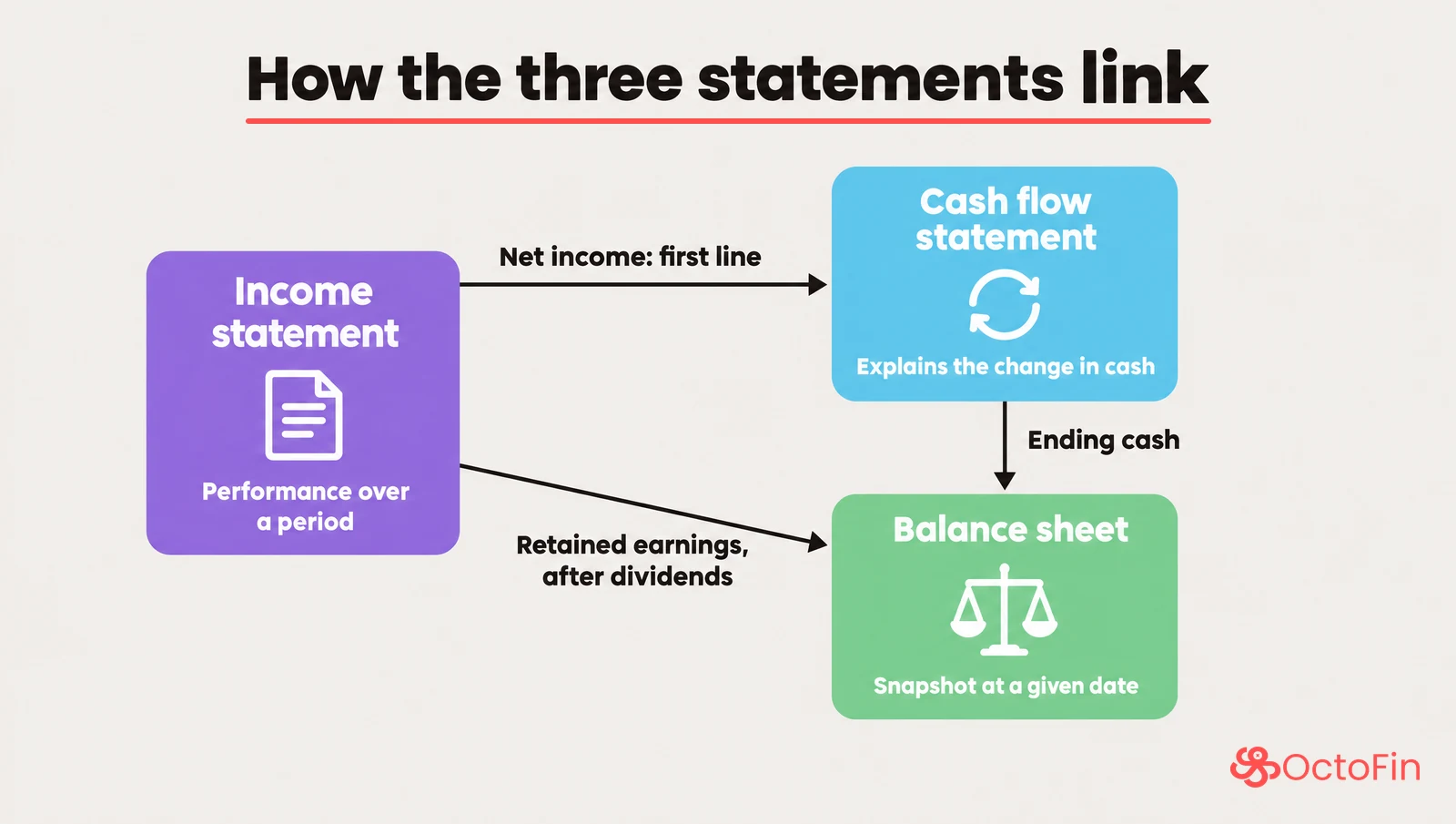
Common mistake: reciting definitions without the links. The links are what the interviewer is after, because every accounting question that follows depends on them. To review them, our accounting cheat sheet for interviews covers the three statements, how they connect and the key formulas (the page is in English, but the PDF itself is in French).
8. Depreciation goes up by $10: walk me through the three statements
Assumption for the example: a tax rate of 25%.
"On the income statement, pre-tax income falls by $10. Taxes fall by $2.50, so net income falls by $7.50. On the cash flow statement, I start from net income, down $7.50, and add back the $10 of depreciation, which is non-cash: cash from operations rises by $2.50, which is the tax saving. On the balance sheet, PP&E falls by $10 and cash rises by $2.50, so total assets are down $7.50. On the other side, shareholders' equity is down $7.50 through retained earnings. The balance sheet balances."
| Statement | Effect |
|---|---|
| Income statement | Pre-tax income −$10; taxes −$2.50; net income −$7.50 |
| Cash flow statement | Net income −$7.50; depreciation added back +$10; change in cash +$2.50 |
| Balance sheet, assets | PP&E −$10; cash +$2.50; total −$7.50 |
| Balance sheet, liabilities and equity | Shareholders' equity −$7.50 |
Common mistake: saying cash goes down. Depreciation doesn't move any cash; only the tax saving touches cash, and it pushes it up.
9. If you could use only one financial statement, which would it be?
"The cash flow statement. It shows whether the business really generates cash, how much it reinvests and how it's funded. It's also the hardest to dress up: earnings depend on accounting choices, cash much less so. If I could have two, I'd take the income statement and the balance sheets at the start and end of the period: with those, I can rebuild the cash flow statement."
Common mistake: picking the income statement "because it shows the profit". A profitable company can run out of cash, and running out of cash is what sinks it.
10. Noncontrolling interest and equity-method investments: where do they go in the bridge?
"Both fix a mismatch between enterprise value and EBITDA. If a group owns 80% of a subsidiary it controls, it consolidates 100% of that subsidiary's EBITDA: enterprise value therefore includes the 20% that isn't the group's, and I subtract noncontrolling interest to get to equity value. Conversely, an equity-method investment, say a 30% stake in a company the group doesn't control, adds nothing to EBITDA, only a share of net income below EBITDA. Its value isn't in enterprise value, so I add it to get to equity value."
Common mistake: flipping the signs. From enterprise value to equity value, you subtract what belongs to others (debt, noncontrolling interest) and add what EBITDA doesn't capture (cash, equity-method investments).
Enterprise value and equity value
11. How do you get from enterprise value to equity value, and why do you subtract cash?
"Enterprise value is the value of the business for everyone who funds it; equity value is what belongs to shareholders. The bridge: enterprise value, minus debt, plus cash, minus noncontrolling interest, plus equity-method investments, and minus preferred stock if there is any. Going the other way, I add net debt to equity value, so I subtract cash. Why? Cash isn't an operating asset: EBITDA doesn't pay for it, and a buyer who gets $100 of cash along with the company is really paying $100 less for the business."
The calculation, with example numbers (in $m):
| Line | Amount |
|---|---|
| Enterprise value | 1,000 |
| − Debt | −400 |
| + Cash | +100 |
| − Noncontrolling interest | −50 |
| + Equity-method investments | +30 |
| = Equity value | 680 |
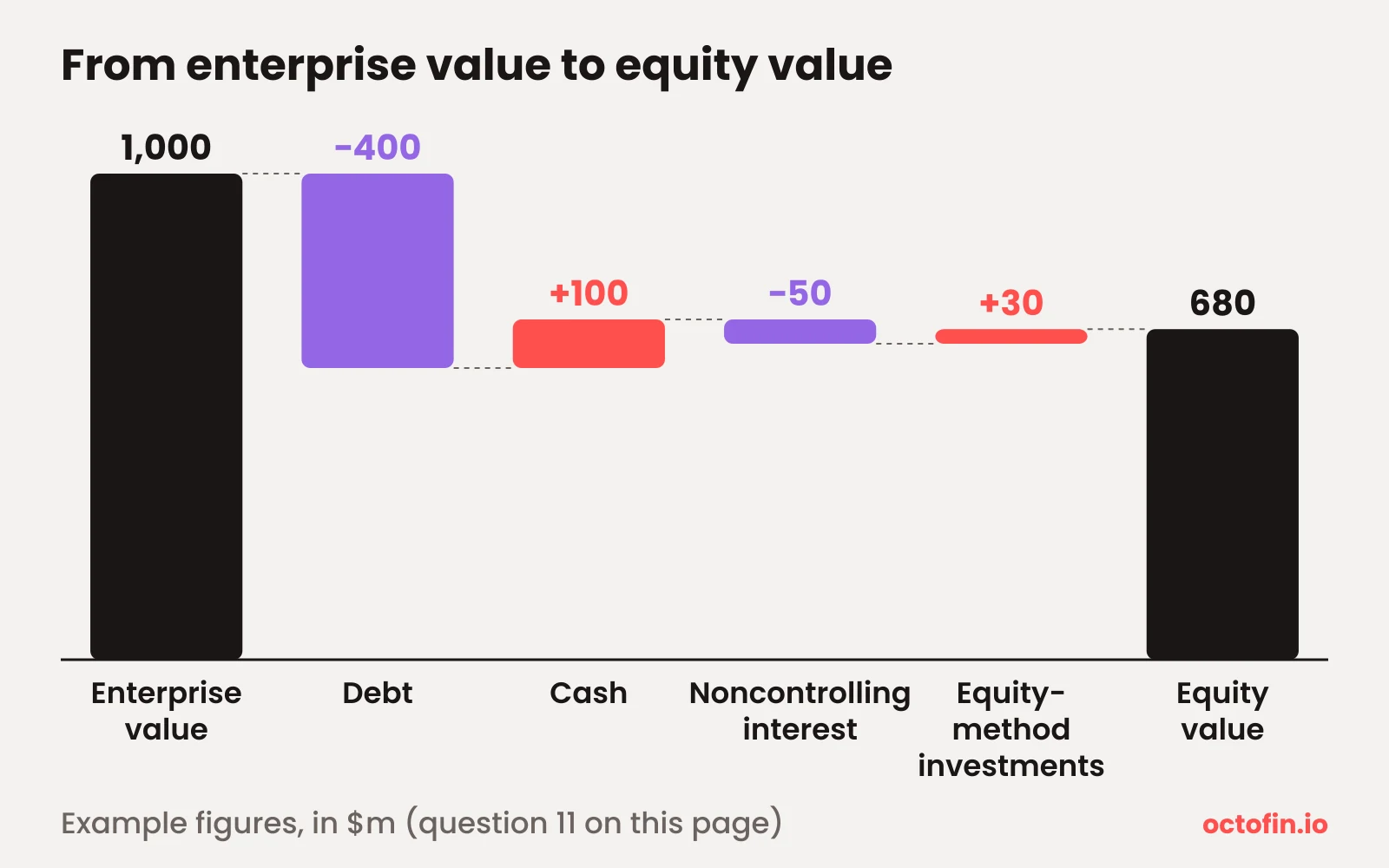
With 34 million diluted shares: 680 / 34 = $20 per share. The other way: 680 + 400 − 100 + 50 − 30 = 1,000.
Common mistake: thinking an equity raise increases enterprise value. If the company issues $100 of new shares and keeps the cash, equity value and cash both rise by $100, and enterprise value doesn't move.
Valuation
12. What are the main valuation methods, and which gives the highest value?
"Three main methods: the DCF, which discounts future cash flows; trading comps, which apply the multiples of similar listed companies; and precedent transactions, which use the multiples paid in past acquisitions. We often add an LBO analysis: the price a financial sponsor could pay and still hit its target return. Precedent transactions usually give the highest value, because the prices paid include a control premium and sometimes synergies. The LBO analysis tends to set a floor, and the DCF can land anywhere depending on the assumptions. It all goes on a football field, a chart that lines up the range from each method."
Common mistake: an absolute answer, like "the DCF, always". The right answer says "usually", then explains why.
13. Walk me through a DCF. Unlevered or levered free cash flow?
"One, I project unlevered free cash flow over five to ten years: EBIT after tax, plus D&A, minus capex, minus the increase in net working capital. Two, I calculate the WACC. Three, the terminal value, either with the perpetuity growth method, next year's cash flow divided by WACC minus the long-term growth rate, or with an exit multiple. Four, I discount everything back to today: that's enterprise value. Five, the bridge to equity value, which I divide by diluted shares. Unlevered free cash flow is before debt service, so it's discounted at the WACC. Levered free cash flow, after interest and debt repayments, net of new borrowing, is discounted at the cost of equity and gives equity value directly. Banks mostly use unlevered, because it doesn't depend on the capital structure."
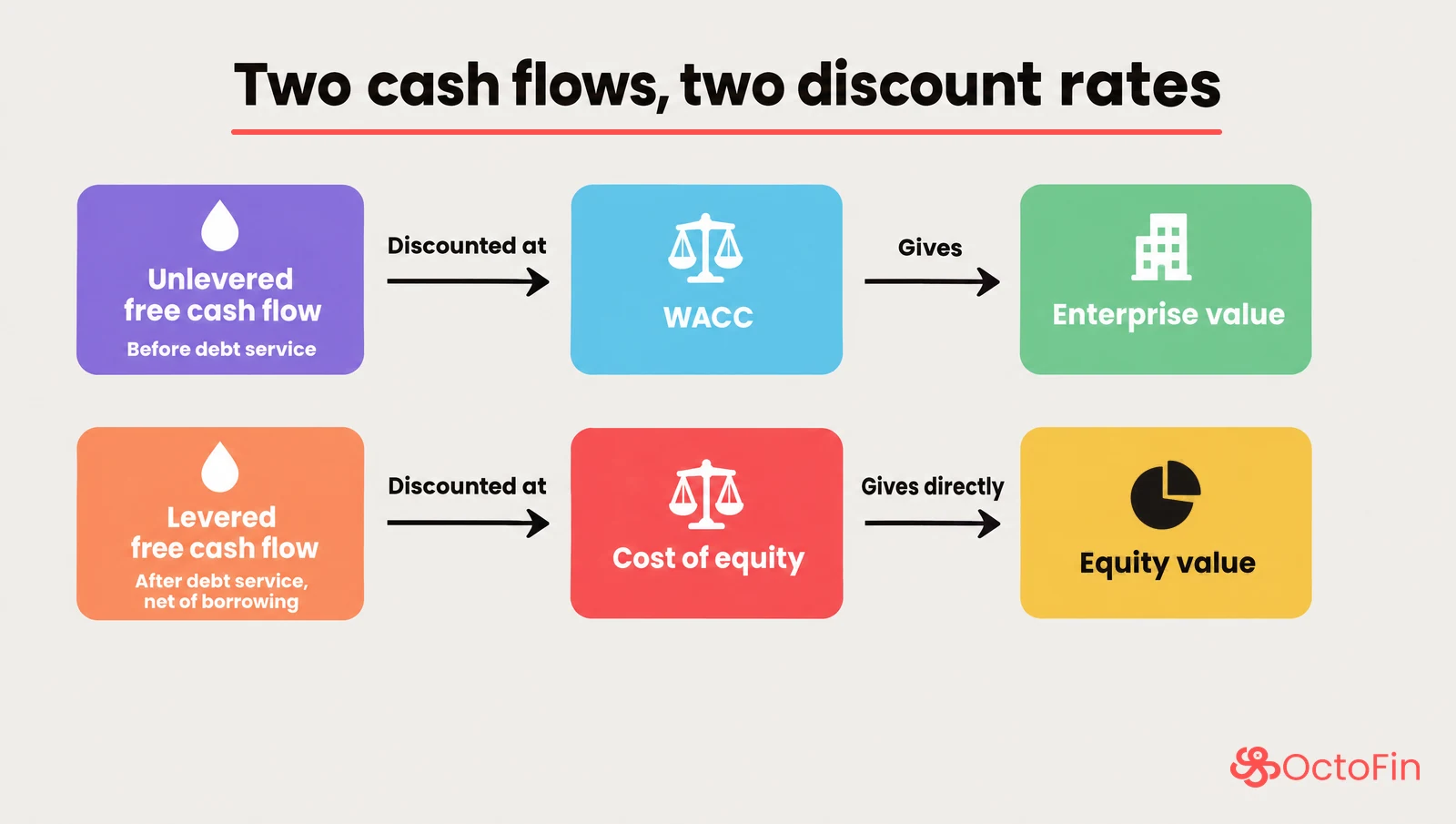
Common mistake: discounting unlevered free cash flow at the cost of equity, or starting from net income without adding back after-tax interest. Starting from net income is fine if you do: unlevered FCF = net income + interest × (1 − tax rate) + D&A − capex − increase in net working capital.
14. Explain WACC, CAPM and beta
"WACC is the average cost of the company's funding: the cost of equity and the after-tax cost of debt, weighted by their market values. The cost of equity usually comes from the CAPM: the risk-free rate plus beta times the equity risk premium. Beta measures how sensitive the stock is to the market: with a beta of 1.2, when the market rises 1%, the stock rises 1.2% on average. Since beta depends on leverage, we unlever the comps' betas, then relever them at the target capital structure."
The calculation, with example assumptions: risk-free rate 3%, beta 1.2, equity risk premium 5%, pre-tax cost of debt 5%, tax rate 25%, 30% debt and 70% equity.
Cost of equity: 3% + 1.2 × 5% = 9%. After-tax cost of debt: 5% × (1 − 25%) = 3.75%. WACC: 70% × 9% + 30% × 3.75% = 6.3% + 1.125% ≈ 7.4%.
Common mistake: concluding that more debt always lowers the WACC. Past a certain level, default risk pushes up both the cost of debt and the cost of equity.
15. Which multiples do you use? NTM or LTM?
"A consistent multiple: enterprise value goes over a metric before interest, such as EBITDA, EBIT or revenue; equity value goes over a metric after interest, such as net income, which gives the P/E. EV/EBITDA is the most widely used, because it depends neither on the capital structure nor on depreciation policy. EV/revenue is for companies that aren't profitable yet. For trading comps, I'd rather use NTM, the next twelve months, because the share price reflects expectations. For precedent transactions, often LTM, the last twelve months, which is what the buyer knew when the deal was struck."
Common mistake: dividing enterprise value by net income. Numerator and denominator must refer to the same providers of capital.
16. Is EBITDA a good proxy for cash flow?
"It's a starting point, not a cash flow. EBITDA ignores capex, changes in working capital, taxes and interest. In a capital-intensive sector like telecoms, a company can post a comfortable EBITDA and generate almost no cash. Leases matter too, and here US and international companies differ. Under IFRS 16, most leases sit on the balance sheet and their cost shows up as depreciation and interest, both below EBITDA. Under US GAAP, ASC 842 also puts operating leases on the balance sheet, but their cost stays a single straight-line expense within operating costs, so it's still inside EBITDA. Same business, higher EBITDA under IFRS. For a quick answer, I'd look at EBITDA minus capex; for a real one, free cash flow."
Common mistake: answering yes or no. The interviewer expects "it's an approximation, and here's what it leaves out", and, when you compare a US company with a company reporting under IFRS, a word on leases.
M&A
Interviewing for an M&A group? These M&A interview questions, along with the recent deal (question 24) and the sell-side process (question 25), are the ones to know cold.
17. Is a stock acquisition accretive or dilutive?
"I compare P/E ratios. In an all-stock deal, before synergies and fees, the acquisition is accretive to earnings per share when the acquirer's P/E is higher than the P/E paid for the target: the acquirer pays with an expensive currency, its own shares, to buy cheaper earnings. In an all-cash deal, I compare the after-tax cost of the debt, or the interest given up on the cash, with the target's earnings yield, the inverse of the P/E paid."
The calculation, with example numbers:
- Acquirer: net income of $100m, 50 million shares, so earnings per share (EPS) of $2.00; share price of $30, so a P/E of 15x.
- Target: net income of $40m, bought for $480m entirely in stock, so a P/E paid of 12x.
- New shares issued: 480 / 30 = 16 million.
- Pro forma EPS: (100 + 40) / (50 + 16) = 140 / 66 ≈ $2.12, about +6.1%. Accretive: 15x is above 12x.
- Same target bought for $720m (a P/E paid of 18x): 24 million new shares, EPS = 140 / 74 ≈ $1.89, about −5.4%. Dilutive.
In cash, with debt at 5% before tax: 3.75% after tax, against an earnings yield of 1 / 12 ≈ 8.3% for the target bought at 12x. Accretive.
Common mistake: treating accretive as a good deal. An accretive deal can destroy value if the price is too high; and synergies, fees and the amortization of intangibles written up in the purchase price allocation all change the math.
18. Why do companies buy other companies?
"To grow faster than they could on their own: gain market share or consolidate an industry, enter a new geography, get a technology or customers, and above all capture synergies. Cost synergies, such as combined purchasing or shared support functions, are the most reliable. Revenue synergies, such as cross-selling, are less certain. The deal creates value if the synergies, net of the cost of achieving them, are worth more than the premium paid to the seller."
Common mistake: citing diversification as a good reason, with no caveat. Shareholders can diversify on their own by buying other stocks; they have no reason to pay a premium for it.
19. Earn-out, carve-out, spin-off: what's the difference?
"An earn-out is deferred consideration: part of the price is paid after closing if the target hits agreed targets, for example an EBITDA level. It bridges the gap between an optimistic seller and a cautious buyer. A carve-out is the separation of a business from a group, either to sell it to a buyer or to list part of it in an IPO, which is called an equity carve-out. Either way, the parent receives cash, and the business has to be set up to run on its own, often with transition services agreements, or TSAs. A spin-off is different: the parent distributes the subsidiary's shares to its own shareholders, pro rata. The subsidiary becomes an independent listed company, and the parent receives no sale proceeds."
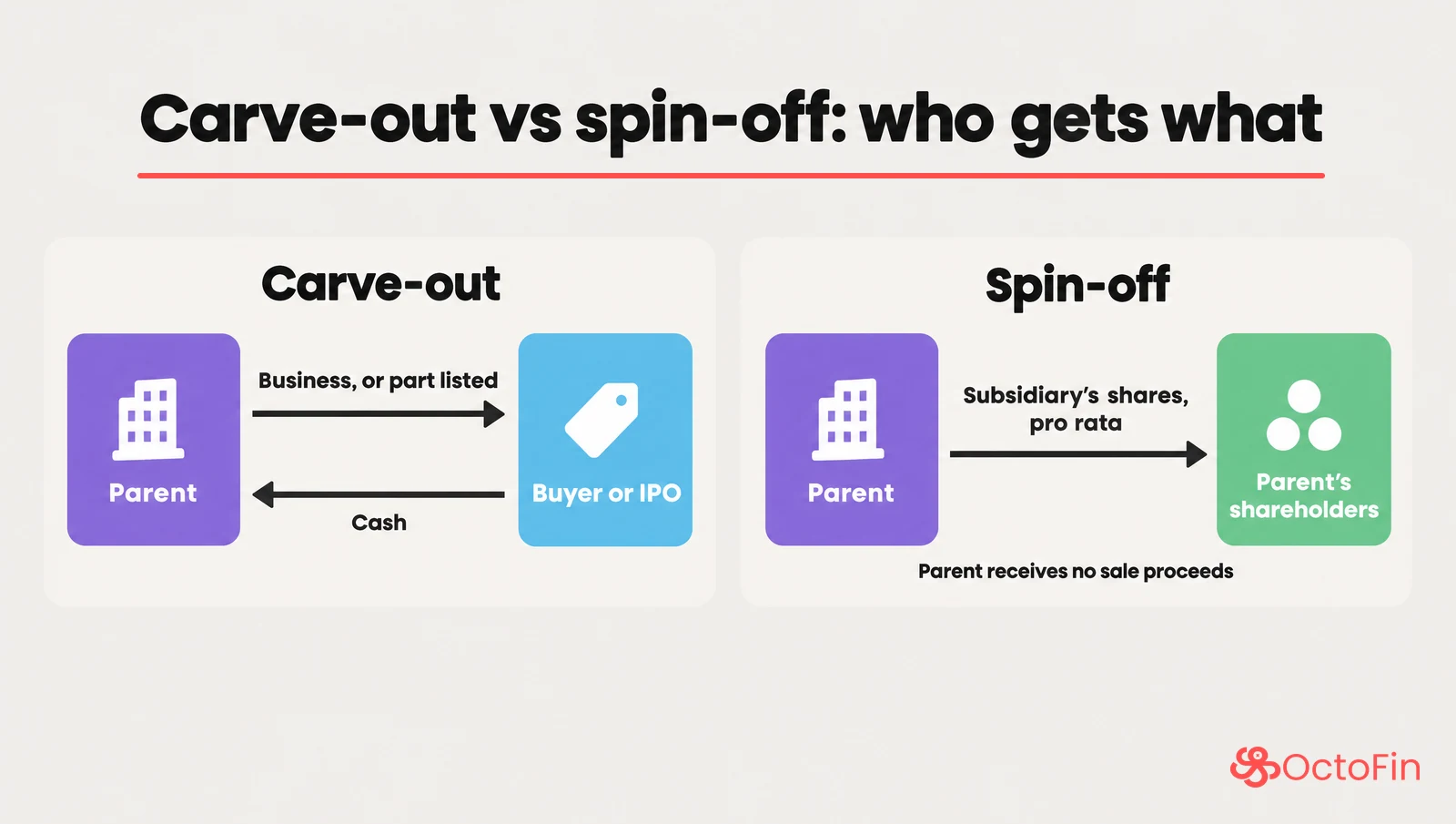
Common mistake: saying the parent "sells" its subsidiary in a spin-off. Nobody buys anything: existing shareholders receive the shares.
LBOs
20. What makes a good LBO candidate?
"A company that can pay down a lot of debt with its own cash flows: stable, predictable cash flows, solid margins, low required capex, well-managed working capital. Then a strong market position, a good management team, little debt to begin with, and room for improvement, such as add-on acquisitions. Finally, a clear exit. There are three value creation levers: EBITDA growth, debt paydown from cash flow, and possibly multiple expansion between entry and exit."
Common mistake: suggesting a fast-growing but loss-making startup. It may be a great company, but it can't carry debt.
21. Why use so much debt in an LBO?
"Because debt is cheaper than equity and its interest is tax-deductible. Above all, the larger the share of the price funded with debt, the less equity the sponsor puts in: for the same gain, its return is higher. But leverage cuts both ways: if the value falls, the equity absorbs the loss first."
The calculation, with example numbers (interest and repayments ignored, to isolate the effect of leverage): a company bought for $100m and sold for $150m five years later.
| No debt | With $60m of debt | |
|---|---|---|
| Equity invested | $100m | $40m |
| Equity at exit | $150m | 150 − 60 = $90m |
| Multiple (MOIC) | 1.5x | 2.25x |
| IRR over 5 years | ≈ 8.4% | ≈ 17.6% |
| If the exit is at $80m | 0.8x | (80 − 60) / 40 = 0.5x |
Common mistake: presenting debt as free. It costs interest, comes with repayments and covenants, and can turn one bad year into a default.
22. What types of debt are used in an LBO?
"From safest to riskiest for the lender: first, senior secured debt, meaning the revolver, an amortizing Term Loan A and a Term Loan B that's mostly repaid at maturity. In highly leveraged US LBOs, a second-lien term loan is a relatively common addition behind it. Instead of separate senior and junior loans, a direct lender can provide a unitranche, a single loan that combines both. On larger deals, high-yield bonds, usually behind the secured loans. Then mezzanine, the most junior and most expensive debt. The more junior the debt, the later it's repaid and the more it costs."
| Debt | Ranking | Repayment | Relative cost |
|---|---|---|---|
| Revolver (RCF) | Senior secured, first lien | Drawn and repaid as needed | Lowest |
| Term Loan A | Senior secured, first lien | Meaningful amortization over its life | Lowest |
| Term Loan B | Senior secured, first lien | Minimal: about 1% a year in the US, the bulk at maturity | A bit higher |
| Second-lien term loan | Secured, behind the first lien | The bulk at maturity, usually after the Term Loan B | Higher than first lien |
| Unitranche | One tranche combining senior and junior debt | Mostly at maturity | Above senior debt |
| High-yield bonds | Usually behind the secured loans (secured, unsecured or subordinated, depending on the issue) | At maturity | High |
| Mezzanine | Subordinated, the last of the debt | At maturity | The highest of the debt: interest partly paid in kind (PIK), often with warrants |
A US Term Loan B in numbers: on a $400m loan amortizing 1% a year, the company repays $4m a year. After five years, $380m is still outstanding: most of the loan is repaid at maturity, or refinanced before.
Common mistake: forgetting the equity, from the sponsor and sometimes from management. It's paid after all the debt and takes the most risk.
23. Mini paper LBO: do it in your head
The setup, with example numbers: EBITDA of $40m; bought at 7x; debt of 4x EBITDA at 5%, repaid in a single bullet at maturity; EBITDA grows by $4m a year; D&A = capex = $8m a year; net working capital flat; cash earns no interest; tax rate of 25% (assumption); exit after 5 years at the same 7x; no fees; the sponsor targets a 20% IRR.
Step 1, entry. Enterprise value: 7 × 40 = $280m. Debt: 4 × 40 = $160m. Equity: 280 − 160 = $120m. Interest: 5% × 160 = $8m a year.
Step 2, cash flows. Net income = (EBITDA − $8m of D&A − $8m of interest) × 0.75. With D&A equal to capex and working capital flat, free cash flow equals net income.
| Year | EBITDA ($m) | Pre-tax income ($m) | Net income = free cash flow ($m) |
|---|---|---|---|
| 1 | 44 | 28 | 21 |
| 2 | 48 | 32 | 24 |
| 3 | 52 | 36 | 27 |
| 4 | 56 | 40 | 30 |
| 5 | 60 | 44 | 33 |
| Total | 135 |
Mental shortcut: EBITDA adds up to 260; minus 5 × 16 = 80 leaves 180; 180 × 0.75 = 135.
Step 3, exit. Enterprise value: 7 × 60 = $420m. The debt is a bullet, so the $135m of cash flow piles up as cash: net debt of 160 − 135 = $25m. Equity at exit: 420 − 25 = $395m.
Step 4, returns. Multiple: 395 / 120 ≈ 3.29x. IRR without a calculator: 1.25 to the fifth power ≈ 3.05 and 1.27 to the fifth power ≈ 3.30, so about 27% (26.9% on a calculator).
Step 5, the call.
"I'd invest: 3.3x and about 27% IRR, above the 20% target. Of the $275m of value created, $140m comes from EBITDA growth, 20 times 7, and $135m from deleveraging, the cash that builds up against the bullet loan, with no multiple expansion. The main risk is growth: I'd check that it's realistic. Even with an exit at 6x, we still get 2.8x and about 23%."
The 6x follow-up: 6 × 60 = $360m, minus $25m of net debt, leaves $335m; 335 / 120 ≈ 2.79x, an IRR of about 22.8%.
And if the debt were a US-style Term Loan B amortizing 1% a year? $1.6m a year would go to repaying debt instead of building up as cash. Net debt at exit barely moves: about $24.4m instead of $25m (with interest charged on the balance at the start of each year), the difference being the after-tax interest saved on the debt already repaid.
Common mistake: applying the exit multiple to equity instead of enterprise value, forgetting taxes or interest, or stopping at the IRR without a recommendation. The interviewer wants a decision. If the setup doesn't give a target return, ask for one.
Market questions
24. Walk me through a recent deal
No ready-made deal here: a borrowed answer gets spotted by the second follow-up question. Pick a deal announced in the last few months, ideally one the bank you're meeting advised on, read the press release and one or two articles in the financial press, then answer in five points: the parties and their advisors; the deal rationale; the terms (price, multiple if published or calculable, premium for a listed target, cash or stock); your view on the price and the risks; next steps (approvals, expected closing).
"I followed [acquirer]'s acquisition of [target], announced in [month]. The rationale is [one sentence]. The price is [published amount], about [x] times EBITDA based on the published figures, paid [in cash, in stock, or both]. I find the deal [convincing / expensive] because [argument]. The main risk is [risk]. Closing is expected [announced timing]."
Common mistake: a mega-deal you only know from the headline, with no multiple and no view. Better a mid-sized deal you know end to end, numbers included.
25. Walk me through a sell-side M&A process
"For an auction: preparation, with the mandate, sell-side (vendor) due diligence, the teaser, the confidential information memorandum, or CIM, and the buyer list; a first round, where interested parties sign an NDA, receive the CIM and submit a non-binding indication of interest, or IOI; a second round, where a few bidders get data room access and meet management before submitting a binding offer; then negotiation, signing, approvals and closing."
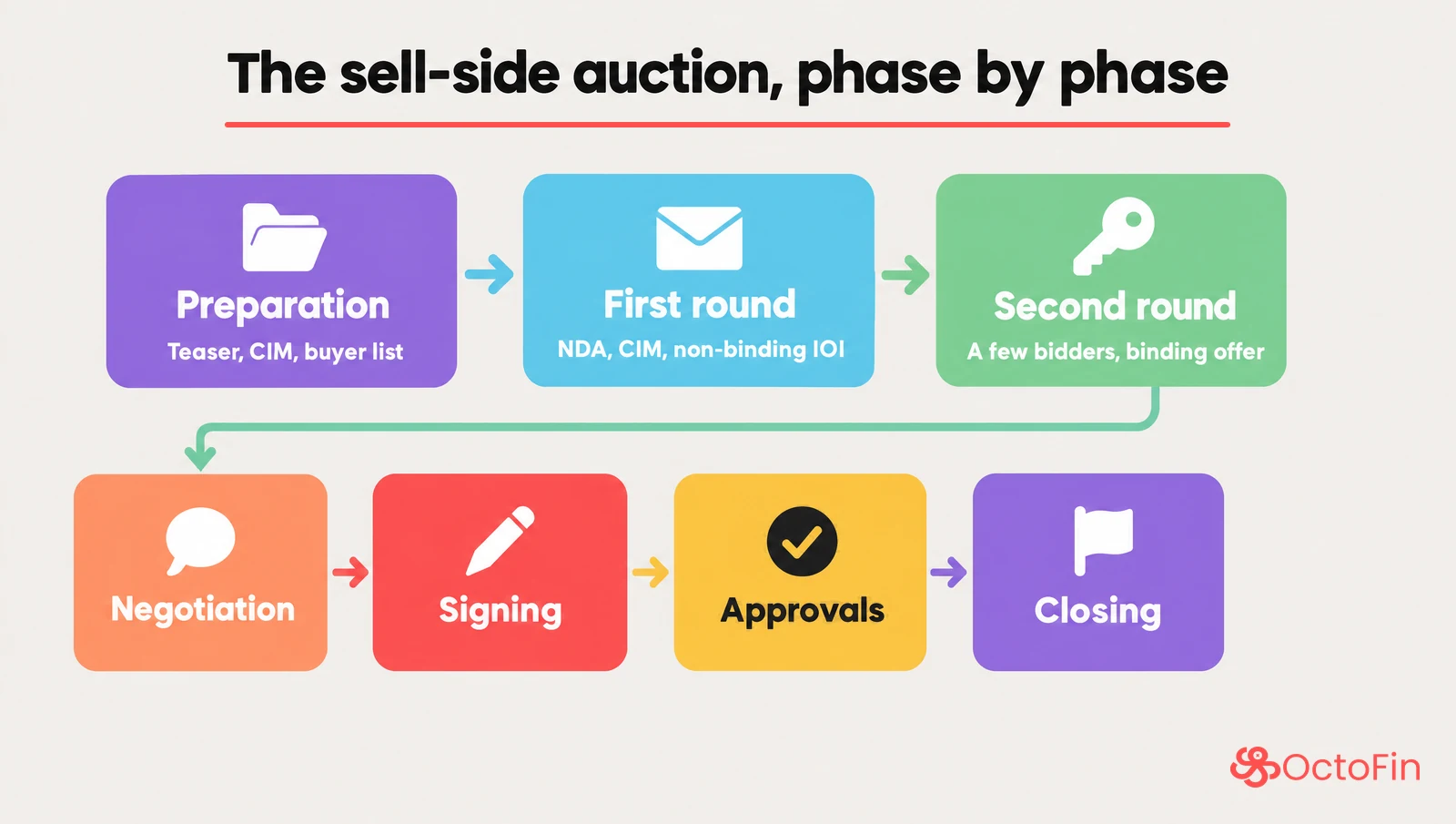
| Phase | Key documents | What the analyst does |
|---|---|---|
| Preparation | Teaser, CIM, model, buyer list | Drafts the materials, builds the model, identifies buyers |
| First round | NDA, indications of interest | Tracks the conversations, compares the bids |
| Second round | Data room, management presentation, draft purchase agreement | Populates the data room, prepares answers to buyers' questions |
| Signing | Binding offer, purchase agreement (SPA) | Updates the bid analysis |
| Closing | Approvals, payment of the price | Tracks the closing conditions |
Common mistake: confusing signing and closing. In between, the deal needs its approvals. In the US, deals above a minimum size generally must be notified to the FTC and the Department of Justice under the Hart-Scott-Rodino (HSR) Act, and the parties must then wait 30 days before closing (15 for a cash tender offer), unless the agencies end the waiting period early; a "second request" from the agency extends that wait. When the buyer is foreign, the deal may also be reviewed by CFIUS, the committee that examines foreign investment in US businesses for national security.
If you interview in Paris. In France, a company with at least 50 employees must consult its works council, the CSE (comité social et économique), before the seller commits to the sale. So the chosen buyer usually signs a promesse d'achat first: a commitment to buy that the seller can exercise once the consultation is over. The seller then exercises it, and the purchase agreement is signed.
26. What moves a stock price?
"The gap between what happens and what the market expected. Rising earnings can send a stock down if they come in below consensus. The main drivers: results and management guidance; interest rates, which change the discount rate; the economy and the sector; corporate events, such as an acquisition or a buyback; and flows, such as being added to an index. In an acquisition, the target's stock usually moves toward the offer price, and the acquirer's can fall if the market thinks it's overpaying."
Common mistake: "good results push the stock up." Not if they're below expectations.
The brainteaser
27. A market sizing question, then a time value of money question
The estimate: "How many pizzas are delivered on a Friday night in a city of 250,000 people?" The numbers are assumptions, stated as such.
"I'll start from households: at 2.5 people per household, that's 100,000 households. I'll assume 10% order a delivered meal on a Friday night, so 10,000 orders, a third of them pizza: about 3,300 orders. At one and a half pizzas per order, about 5,000 pizzas. Sanity check: with about thirty pizzerias delivering, that's roughly 170 pizzas each, which sounds plausible."
The time value question: "Would you rather have $100 today or $110 in a year?"
"It depends on the rate I can earn on my money. $110 in a year is worth 110 / (1 + rate) today. At 8%, about $101.85: I take the $110 in a year. At 12%, about $98.21: I take the $100 now. At 10%, I'm indifferent. And I'd consider the risk of not getting paid."
Common mistake: looking for THE right answer to the estimate. The interviewer grades your approach: stating assumptions, calculating cleanly, sanity-checking the order of magnitude. On time value: answering "$110, it's more" without mentioning a rate.
At the end: your questions for the interviewer
28. "Do you have any questions for me?"
Always say yes, with two or three questions prepared for this particular person. Good questions are about their experience and the job, and the answers teach you something you couldn't find online:
- "Without naming clients, what did your last week look like, and what did the analyst on your team own?"
- "What separates the analysts who stand out in their first year?"
- "How has your work changed since you joined the team?"
- "Which deal are you proudest of, and why?"
- "What would you expect a summer analyst to own by the end of the internship?"
Adapt to who's in front of you: an analyst can describe the day-to-day, a managing director the group's strategy and clients. You can also come back to something they said earlier: it shows you were listening.
Common mistake: "No, I think you've covered everything." Also avoid questions answered on the bank's website, and questions about pay or vacation in an early round.
Frequently asked questions
What kind of questions are asked in an investment banking interview?
Three kinds. Fit and behavioral questions: your story, why banking, why this bank, strengths and weaknesses, teamwork and failure. Technical questions: accounting, enterprise value, valuation, the DCF, M&A and LBO math. Market questions: a recent deal, what moves a stock price. Some interviews add a brainteaser or a market sizing question, and end with your own questions for the interviewer. The table at the top of this page maps the 28 questions to these blocks.
Why do you want to work in investment banking?
Good reasons are specific and backed by something you've done: the learning curve on live transactions, the exposure to clients and senior bankers, the teamwork under deadlines. Money, prestige or exit opportunities on their own are weak reasons, and so is an answer that would fit any finance job. A full answer, ready to adapt and say out loud, is in question 2.
What should you expect in a first-round investment banking interview?
The first round checks the basics: a clear walk through your resume, a credible "Why investment banking?", "Why this bank?" and a few standard technicals, such as the three statements, enterprise value versus equity value and the steps of a DCF. Later rounds go deeper: harder technicals, a deal discussion, sometimes a case study or a paper LBO, and a final round with several interviews in a row.
How do you prepare for an investment banking interview?
Prepare the three blocks: short, correct technical answers; a consistent fit story (your background, your motivation, your choice of bank); and two or three deals you know in detail. Practice out loud, time yourself, redo the math by hand. On the day, listen to the whole question, structure your answer, and prefer "I'm not sure, but here's how I'd think about it" to a made-up answer.
What is M&A in investment banking?
M&A stands for mergers and acquisitions: buying, selling or combining companies or businesses. In an investment bank, the M&A team advises the buyer or the seller: it values the company, finds counterparties, runs the process and helps negotiate. It's an advisory job, distinct from financing teams such as leveraged finance. M&A skills are also used in corporate development teams inside companies, in transaction services teams that run financial due diligence, and at law firms. In a bank, you start as an intern or analyst, then move up to associate, vice president, director and managing director. For the big picture of corporate finance, our world of finance summary maps the industry in four pages, with a glossary (the PDF is in French, like our accounting cheat sheet; both are on the resources page).
Practice until interview day
Reading 28 answers isn't enough: you need to say them until they come out without effort. OctoFin brings together more than 1,000 practice questions, as multiple choice, flashcards or free response, lessons from accounting to LBOs, and more than 1,300 reports on real interviews. We don't publish a breakdown of these reports by bank or country: if you're recruiting in New York or London, check that your target banks are covered before relying on them. For the plans, go to the home page: OctoFin pricing. And if you can get a mock interview with a banker, do that too: OctoFin doesn't offer one-on-one coaching.