M&A Analyst: What the Job Is, a Worked Example, and How to Get the Internship
- M&A
- Careers
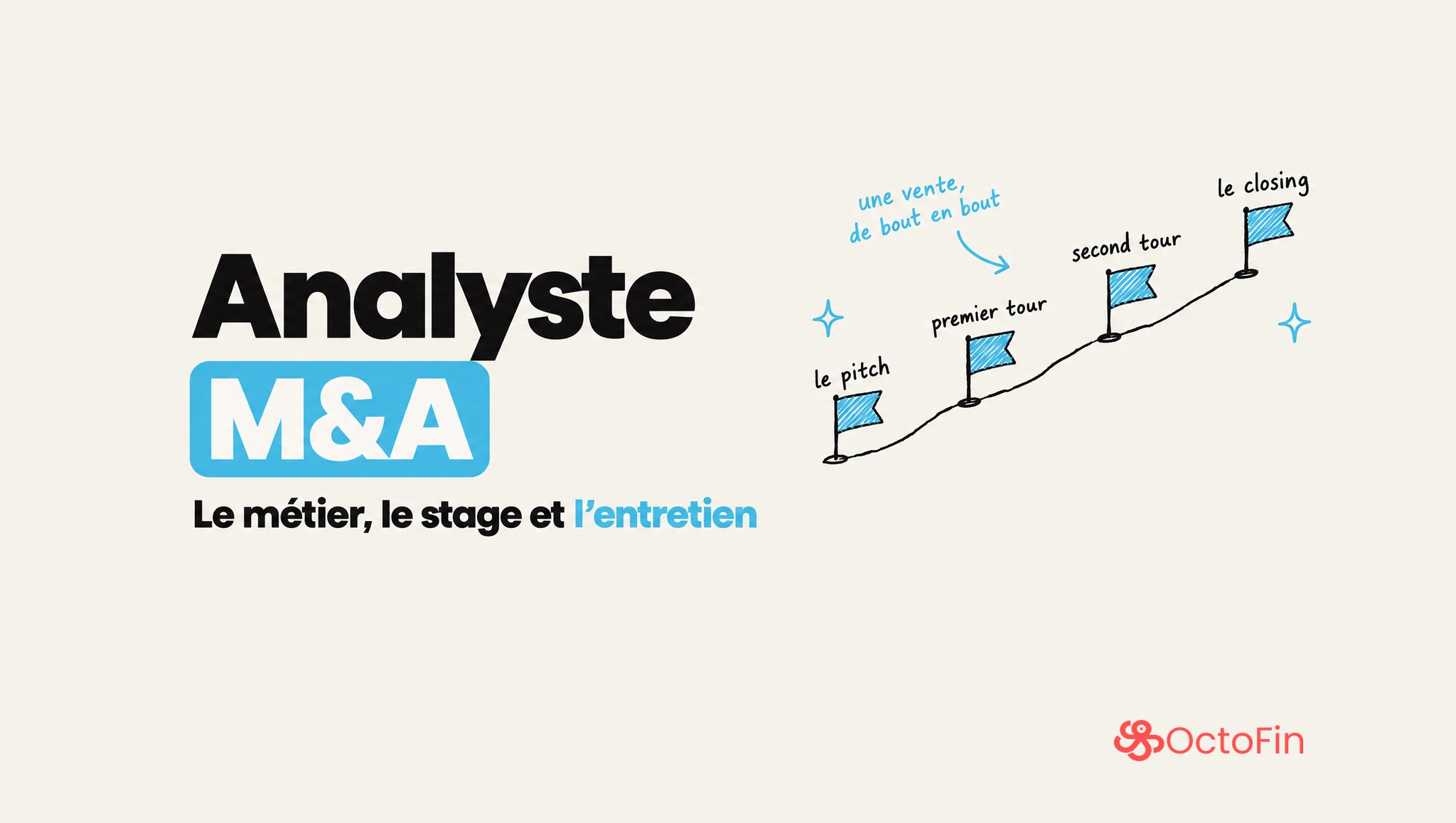
An M&A analyst is the entry-level member of the team that advises a company or its owners on a merger, an acquisition or a sale, at an investment bank or an advisory firm: the analyst builds the models, drafts the documents, compares the offers and follows the deal to closing. Below: what the job involves, how a sale process runs, four buyer offers compared step by step, how the role differs from an investment banking analyst, and how to get the internship, from sources read on October 28, 2026 and rechecked on November 16, 2026.
Four letters arrive at the bank running the sale of a company. The first quotes an enterprise value, the second a price for the shares, the third slips in an earn-out, the fourth names a multiple. The seller asks one question: which offer is best? Answering it is part of an M&A analyst's job. In its Paris Large Cap internship offer, still online on November 16, 2026, Rothschild & Co puts offer analysis (analyse d'offres) among the tasks of executing a mandate.
This guide is for students discovering M&A or preparing for an internship. It covers what an M&A analyst does, how a sale process runs, a worked example where you rank four offers yourself, how the role differs from an investment banking analyst, the way in and the interview. Each fact about a firm, an offer or a career path is attributed to a named source, all read on October 28, 2026 and rechecked on November 16, 2026 (bank program pages, internship offers, two career guides, two analyst testimonials and a few reference texts); the deal-process and job-comparison tables are general descriptions, and the worked example is made up. You won't find pay or working hours in figures: the FAQ explains why.
The M&A analyst in two sentences
At a bank or an advisory firm, the M&A analyst works for a client, the seller or the buyer, never for the firm's own account: it's an advisory job, and the analyst produces the analyses, models and documents behind that advice. The analyst is also the most junior member of the deal team: Brian DeChesare, author of the analyst guide on the careers site Mergers & Inquisitions (M&I), puts analysts one rung above summer interns, close to the bottom of the ladder.
The title changes from one firm to the next. Lazard advertises an "M&A Internship", Rothschild & Co recruits for its Global Advisory division, and JPMorgan hires investment banking analysts who then join one of its groups, Advisory among them. "Mergers and acquisitions analyst" is just the long form of the same title. M&A also happens inside companies, in corporate development teams that buy and sell businesses for their own group; DealRoom, a deal management software company, calls that "the in-house version of M&A". It's a different job, covered further down.
What does an M&A analyst do?
The offers and program pages read for this guide describe the same blocks of work under slightly different labels. Lazard's Paris offer splits the job three ways: origination (preparing pitches to win mandates), execution (running the deals) and coverage (in-depth research on the sectors and companies the team follows).
| Block | What the analyst does | Who describes it |
|---|---|---|
| Origination | Pitch materials; tracking investors and market dynamics; research on the industries clients operate in, to support senior bankers' marketing; company profiles and presentations; reviews of companies' financial positions | Lazard (Paris), Rothschild & Co (London and Paris) |
| Coverage and market watch | Research papers on the sectors and companies covered; following the debt and equity markets | Lazard (Paris), Rothschild & Co (Paris) |
| Deal documents | Teaser, information memorandum and other marketing documents; process documents; reports | Lazard (Paris), a Natixis Partners analyst interviewed by Dauphine-PSL, a Crédit Agricole Midcap Advisors analyst, JPMorgan |
| Running the process | Identifying and contacting potential buyers; coordinating the transaction with the client, its counterparties and the other advisers; analyzing offers; taking part in negotiations | Natixis Partners analyst (Dauphine-PSL), Rothschild & Co (London and Paris), Lazard (Paris) |
| Models and valuation | Building and editing Excel models, applying several valuation techniques; financial analyses and models | JPMorgan, Rothschild & Co (London and Paris), Lazard (Paris) |
Two first-hand accounts fill in the picture. On Dauphine-PSL's careers page (undated), Guillaume du Repaire, presented as an M&A analyst at Natixis Partners, says that on a sale you identify and contact potential buyers, draft the marketing documents, model and coordinate the other advisers. Vincent B., an M&A analyst at Crédit Agricole Midcap Advisors, describes in an undated testimonial on the group's careers site the materials used to market a company to investment funds and trade buyers, the financial modeling, and support for the directors who prospect for new clients. DealRoom's career guide, written by its founder Kison Patel, who says he worked as an M&A advisor for more than ten years, sums up the seat as "execution-heavy and supervised": three-statement models, DCF valuations, comparables, and the pitchbook and management presentations that the vice president and managing director take to clients.
How the time splits. On M&I, DeChesare offers his own estimate of an investment banking analyst's "average case": about 50% "PowerPoint for Pitch Books and Other Presentations", 30% "Random and Administrative Tasks", 20% "Excel-Based Financial Modeling and Valuation". He adds that the mix moves with the group: less Excel in equity capital markets, more technical work in restructuring. It's one author's estimate, not a survey, and he adds that even in the most technical groups, modeling and valuation are unlikely to take up half of an analyst's time.
A typical day? The sources agree there isn't one. "There's not really a typical day," says Vincent B. (our translation), because a deal never quite goes as planned. Piper Sandler opens the day-in-the-life section of its US analyst program page with the same line about investment banking, and warns that you may have to travel at a moment's notice.
How a sell-side M&A deal runs, from pitch to closing
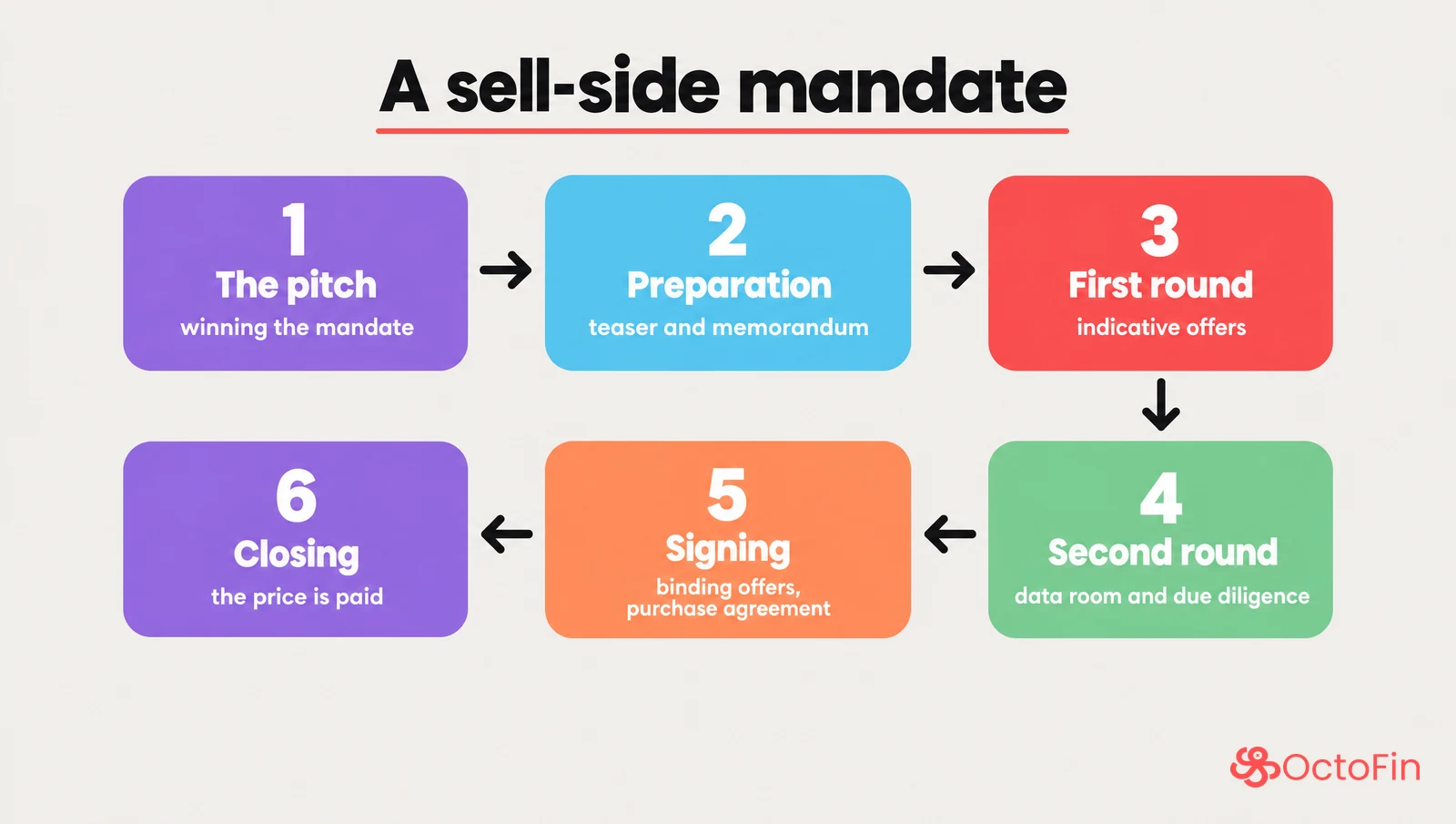
Take one classic mandate: selling a company on behalf of its owner, through a competitive process in two rounds run by the bank. Here are the stages, and the analyst's part in each.
| Stage | What happens | The analyst's part |
|---|---|---|
| 1. The pitch | To win the mandate, the bank presents the owner with its analysis, a first valuation and how it would run the sale | Builds the pitch: market, company, valuation, likely buyers |
| 2. Preparation | Company and bank get ready to go to market; a transaction services team may prepare vendor due diligence (VDD) | Drafts the teaser (a short, anonymous profile) and the information memorandum, builds the model, draws up the buyer list, sets up the data room |
| 3. First round | Interested buyers sign a confidentiality agreement, receive the memorandum and send an indicative, non-binding offer | Handles buyers' requests, then builds the table of offers received (the worked example below) |
| 4. Second round | A short list of bidders gets into the data room, meets management at the management presentation and runs its due diligence | Prepares the management presentation, keeps the data room current, coordinates answers to bidders' questions |
| 5. Binding offers and signing | Bidders send firm offers with their comments on the draft purchase agreement; the seller negotiates, then signs | Updates the offer analysis and tracks the open points |
| 6. Closing | The conditions precedent are met, for instance a regulatory approval; the price is paid and the shares change hands | Tracks the conditions and the timetable |
How long does it all take? "A sale process generally takes 6 to 12 months," according to Vincent B. at Crédit Agricole Midcap Advisors (our translation). He calls the marketing phase quite intense, since the team has to answer requests from the potential buyers it has contacted, and says the pace picks up as closing approaches. None of the sources read for this page gives working hours worth repeating: ask the analysts you meet.
On a buy-side mandate, the path runs the other way: find targets, approach them, submit an offer, run due diligence, negotiate. Vincent B. speaks of mandates to buy, sell or raise funds, and Rothschild & Co's Central and Eastern European internship in London asks interns to help coordinate both sell-side and buy-side processes. The interview version of this process, with its documents and the classic confusion between signing and closing, is question 25 of our investment banking interview questions.
Worked example: ranking four buyer offers
This example is made up, with round, illustrative numbers. It reproduces the analyst's work at stage 3: making offers that don't speak the same language comparable, then ranking them.
The assumptions. A privately held industrial company, owned by its founder, is up for sale. Last year's EBITDA: 12.0. Net debt at the reference date: 30.0. The first round has just closed with four indicative offers. Amounts are in $m (millions of dollars).
Step 1: what the four letters say
| Offer | Bidder | What the letter says | Conditions |
|---|---|---|---|
| A | A buyout fund (LBO) | An enterprise value of 110.0, "cash-free, debt-free" | Acquisition debt still to be confirmed by its banks; confirmatory due diligence (financial, legal, tax) |
| B | A trade buyer from the same industry | A price for the shares of 85.0, based on net debt of 30.0 | Paid from its own cash, with no financing condition; regulatory approval required |
| C | Another fund | An enterprise value of 120.0, "including 18.0 of earn-out" | Earn-out paid if next year's EBITDA reaches 14.0; management must reinvest part of their proceeds; acquisition debt to be confirmed |
| D | Another trade buyer | 9.5 times "normalized EBITDA", which it puts at 11.0 | Paid from its own cash; wants exclusivity as soon as the second round starts |
Read at face value, C (120.0) looks like the best offer and B (85.0) like the worst. That's wrong: the four numbers don't measure the same thing.
Step 2: put every offer on the same basis
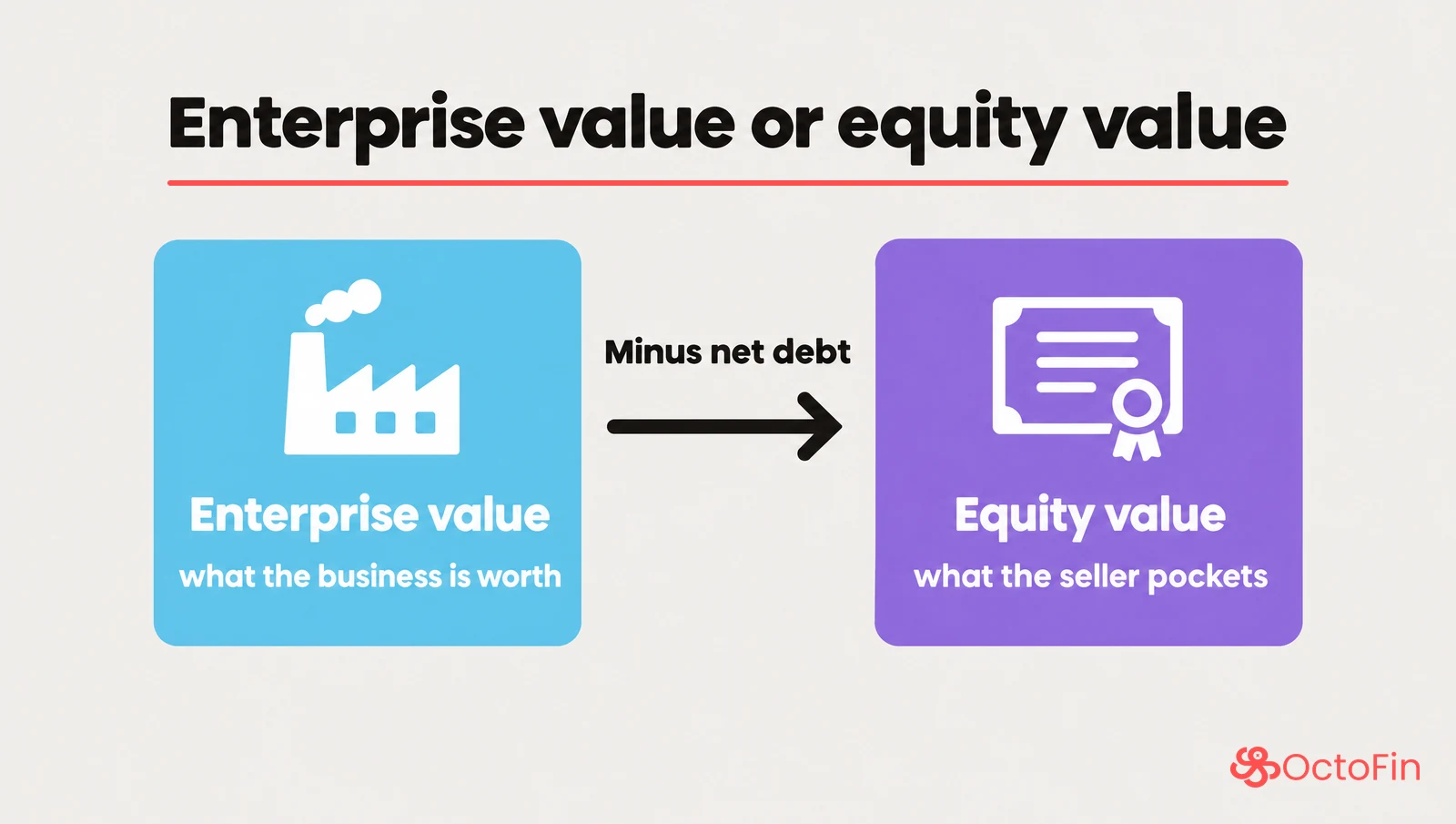
Two notions to keep apart. Enterprise value is what the business itself is worth to all its capital providers, lenders and shareholders together. Equity value, the price for the shares, is what the seller actually pockets: enterprise value minus net debt. A "cash-free, debt-free" offer quotes an enterprise value, so you deduct net debt to see what the shareholder receives.
| Offer | Enterprise value | Equity value, upfront | Equity value, earn-out included |
|---|---|---|---|
| A | 110.0 | 110.0 − 30.0 = 80.0 | 80.0 |
| B | 85.0 + 30.0 = 115.0 | 85.0 | 85.0 |
| C | 120.0 − 18.0 = 102.0 upfront | 102.0 − 30.0 = 72.0 | 120.0 − 30.0 = 90.0, if the target is hit |
| D | 9.5 × 11.0 = 104.5 | 104.5 − 30.0 = 74.5 | 74.5 |
Three traps in one table. Offer B, the lowest at first sight, is a price for the shares: it's actually the highest upfront offer. Offer C, the highest at first sight, depends for 18.0 on a future target. And offer D applies its multiple to an EBITDA of 11.0, not the target's 12.0: the buyer has made its own adjustments, exactly what a transaction services team would scrutinize.
Step 3: the implied multiple
To compare the offers with one another, divide each enterprise value by the same EBITDA: the target's own 12.0.
| Offer | Calculation (upfront) | EV/EBITDA |
|---|---|---|
| A | 110.0 / 12.0 ≈ 9.2x | 9.2x |
| B | 115.0 / 12.0 ≈ 9.6x | 9.6x |
| C | 102.0 / 12.0 = 8.5x (with the earn-out: 120.0 / 12.0 = 10.0x) | 8.5x (10.0x) |
| D | 104.5 / 12.0 ≈ 8.7x | 8.7x |
D announces "9.5 times", but measured on the target's EBITDA, its offer is worth only 8.7 times. A multiple says nothing until you know which EBITDA it's applied to. Note what's missing from this table: a market benchmark. Published medians each cover one region, one deal size range and one period; in an interview, quote one only with its source and what it measures.
Step 4: the ranking, and who goes through to the second round
| Rank | Offer | Upfront equity value | In its favor | Against it | Recommendation |
|---|---|---|---|---|---|
| 1 | B | 85.0 | The highest firm price; no financing condition | A regulatory approval to obtain: a delay and a risk to size up | Second round |
| 2 | A | 80.0 | A firm price; confirmatory due diligence only | Financing still to be confirmed | Second round |
| 3 | D | 74.5 | No financing condition | EBITDA taken at 11.0 instead of 12.0; exclusivity requested too early | Second round, asked to justify its adjustments |
| 4 | C | 72.0 (90.0 with the earn-out) | The highest headline total | 18.0 hinges on next year's EBITDA; management must reinvest | Not kept as it stands; invited to raise its upfront price |
The gap between the top two is 85.0 − 80.0 = 5.0. The bank recommends; the seller decides. Why keep D rather than C? D's shortfall comes from a 1.0 disagreement on EBITDA, a question of numbers the data room can settle. C's rests on a target nobody can guarantee today.
Summed up for the client, or out loud in an interview:
"On a like-for-like basis, offer B is the strongest: $85.0m for the shares, which means an enterprise value of $115.0m, or 9.6 times EBITDA, with no financing condition, but it needs a regulatory approval whose timing we'll have to assess. Fund A comes next at $80.0m, subject to its financing. Offer C only gets to $120.0m with an $18.0m earn-out: its upfront value for the shares is just $72.0m. And D applies 9.5 times to an EBITDA of $11.0m that we'll have to challenge: on our $12.0m, its offer is worth 8.7 times. We recommend taking B, A and D into the second round."
The follow-up questions
"What if fund A assumed net debt of 33.0?" It might, for example, treat 3.0 of provisions as debt: the debt-like items that buyers and sellers argue over in due diligence. Equity value: 110.0 − 33.0 = 77.0. The gap with B widens to 85.0 − 77.0 = 8.0. The ranking holds, the gap doesn't. Hence the question to put to every bidder in the first round: what net debt are you assuming?
"What if D applied its 9.5 times to EBITDA of 12.0?" Enterprise value: 9.5 × 12.0 = 114.0. Equity value: 114.0 − 30.0 = 84.0, just 1.0 below B. The EBITDA disagreement is worth 1.0 × 9.5 = 9.5 of price: that, far more than the multiple, is what to negotiate with D.
"How do you compare an offer that includes an earn-out?" Always show both the upfront amount and the maximum, never the maximum alone. C's target of 14.0 means EBITDA about 17% above last year's 12.0 (14.0 / 12.0 ≈ 1.17), and the buyer will be running the company in the meantime. To match B's upfront value, C would have to raise its fixed price by 85.0 − 72.0 = 13.0.
The step from enterprise value to the price of the shares, the "bridge", is an interview question in its own right; it's answered out loud, item by item, among our investment banking interview questions.
M&A analyst vs investment banking analyst
"Investment banking analyst" is the wider title. JPMorgan's analyst program page says new analysts join one of three kinds of groups:
| Group at JPMorgan | What the bank says it does |
|---|---|
| Advisory | Advises companies and institutions, whatever their sector, on mergers, acquisitions and complex situations |
| Capital Markets | Works with the coverage and M&A teams to serve clients, covering origination, structuring, financing and syndication |
| Coverage (Industry) | Brings industry-specific expertise and regional market knowledge, across sectors such as consumer and retail, healthcare and technology |
So every M&A analyst at a bank is an investment banking analyst, but not every investment banking analyst works on M&A. The page lists the same core tasks for the whole program: writing reports, building financial models, supporting transactions. The difference shows in the mix of work: M&I's DeChesare notes less Excel in equity capital markets and more technical work in restructuring. On November 16, 2026, the only intake that JPMorgan page listed was its 2027 full-time analyst program in London, with a November 30, 2026 deadline: you apply to the program, not to "M&A".
At Lazard and Rothschild & Co, the line between M&A and the rest of advisory blurs too. Rothschild & Co's Paris Large Cap interns are assigned, as needs arise, to Global Advisory teams working on M&A, financing, restructuring, IPOs, credit ratings or strategic advice. Its London off-cycle interns, by contrast, join one of the M&A sector teams. Lazard's financial advisory business covers M&A, restructurings, capital structure and capital raising. Before you apply, check which team an offer is actually for.
Where M&A analysts work
Career guides sort banks into tiers; DealRoom, for instance, lists Lazard among the "elite boutiques" and Piper Sandler among the "middle-market" banks. Those labels belong to the guides, not to any official classification. Here are the kinds of firms behind the sources of this page, in no order of merit, with what each says about itself.
| Kind of firm | Example, and what it says | Source |
|---|---|---|
| A large bank, in an advisory group | JPMorgan: its Advisory groups advise on mergers and acquisitions, next to Capital Markets and Coverage | Program page |
| A firm with a dedicated financial advisory business | Lazard: advice on M&A, restructurings, capital structure and capital raising; Rothschild & Co: a Global Advisory division with M&A sector teams in London | Internship offers |
| A bank positioned between boutiques and the largest banks | Piper Sandler's US program page sets itself against both "boutique investment banks" and "bulge bracket investment banks" | Program page |
| A mid-market advisory arm of a bank | Crédit Agricole Midcap Advisors: mid-cap M&A, with mandates to buy, sell or raise funds | Testimonial |
| A Big Four deals practice | PwC UK: lead advisory for buying or selling businesses and raising capital, next to transaction services and restructuring | Deals page |
| A company's corporate development team | DealRoom: the in-house team owns the whole deal, from target sourcing, evaluation and negotiation to due diligence and post-merger integration | Career guide |
The last row changes the nature of the job: corporate development works for its own group, not for clients.
M&A analyst, transaction services, private equity: how they differ
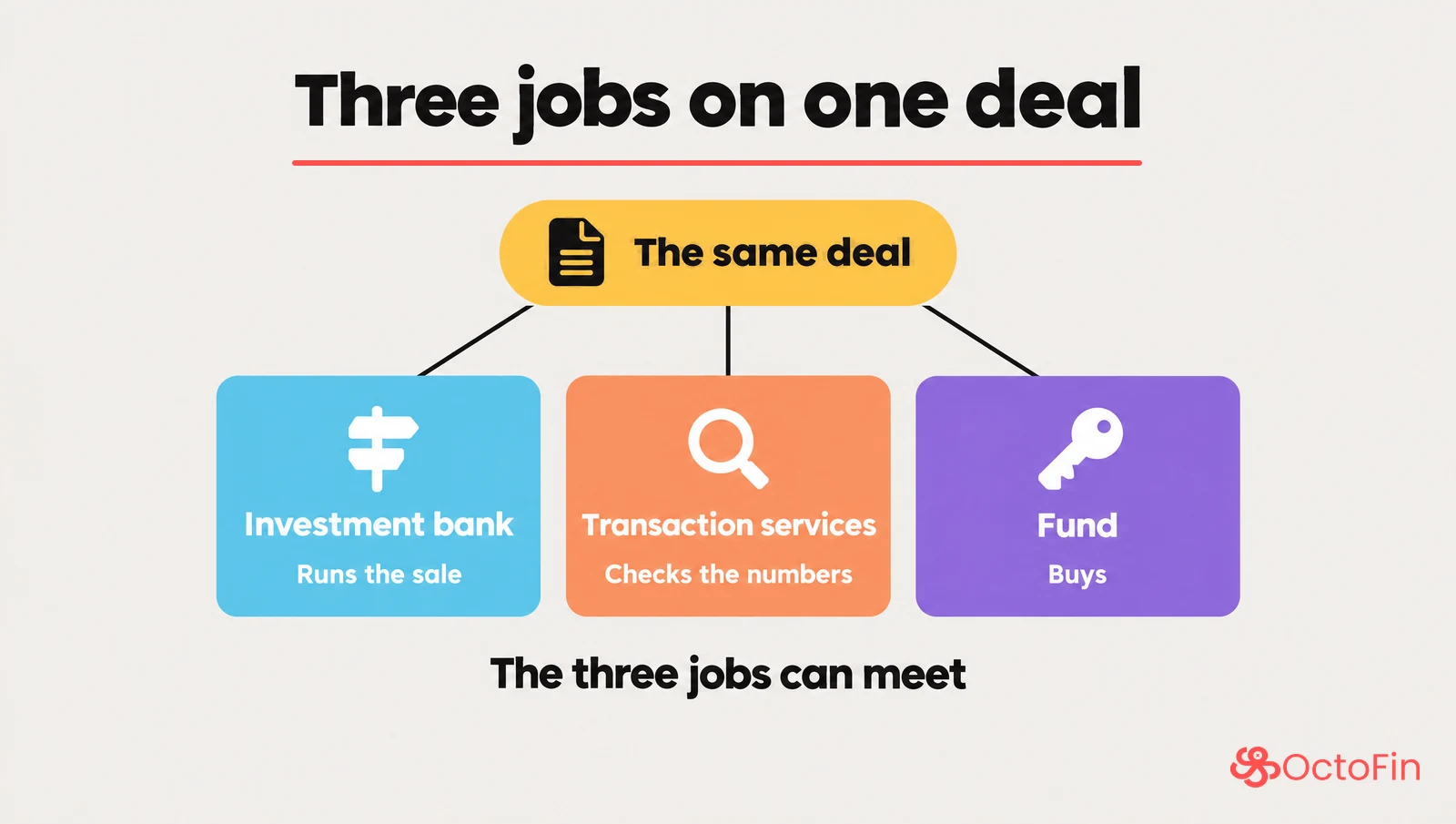
The three jobs can meet on the same deal: an investment bank runs the sale, a transaction services team checks the numbers, a fund buys. Hence the confusion.
| M&A analyst (advisory) | Transaction services | Private equity | |
|---|---|---|---|
| Works for | The client: the seller or the buyer | The buyer, the seller or the lenders | The fund, investing for itself and its investors |
| The question | Which deal, with whom, at what price, and how to run it? | What are the target's earnings, net debt and working capital really worth? | Should we invest, at what price, and how do we grow the company? |
| The deliverable | Pitch, teaser, memorandum, valuation model, offer analysis | Due diligence report, input to the price | LBO model, investment committee memo, portfolio monitoring |
| When | The whole deal, from pitch to closing | During the deal, before signing, then at closing | The investment, then several years alongside management until the exit |
| Core skills | Valuation, modeling, writing, running a process | Applied accounting, Excel analysis, questions to management | LBO modeling, investment judgment, following companies |
Transaction services teams sit in audit and advisory firms, the Big Four among them: PwC UK lists Transaction Services within its Deals practice. The fund's side of the same deal, with a mini LBO worked from the investor's seat, is in how to get into private equity, our guide to the fund side; the structure of a buyout itself, debt and holding company included, is in what is an LBO.
How to become an M&A analyst
The guides read for this page describe a short list of paths in, all built around internships.
| Path | How it works | Source |
|---|---|---|
| Summer internship, then a return offer | Finance internships in the first and second years of university, networking with alumni, a summer investment banking internship at a large bank after the third year, then converting it into a full-time offer | M&I; DealRoom calls a return offer after a summer at a bulge-bracket bank "the single highest-conversion path to a full-time analyst seat" |
| A related job first, then a lateral move | Work after graduation in a related role, such as at a Big 4 firm or a valuation firm, then network and get hired laterally | M&I |
| Other routes | A transaction services job at a Big Four firm, an analyst role in corporate development, or an associate position after a top MBA | DealRoom |
DealRoom names the usual starting point as a two-year analyst program at an investment bank, which students reach through a summer internship in their junior year, and reports that the bulge-bracket banks started taking applications for summer 2027 internships in December 2025 and January 2026. In other words, in the US you apply well over a year before the internship starts. Crédit Agricole Midcap Advisors shows that conversion matters in Europe too: according to Vincent B., its junior full-time hires historically came from former interns, and he presents himself as one of the first outside hires, after four years at EY.
In Paris and London: long internships. Alongside summer programs, the European offers read for this page, all still online on November 16, 2026, include internships of five or six months. In Paris, Rothschild & Co's Large Cap offer is a six-month internship for students on a gap year or at the end of their studies, and caps applications at three offers per calendar year; Lazard's Generalist team internship starts in July 2027 for six months and asks for a first internship in the financial sector. In London, Rothschild & Co's UK Global Advisory off-cycle internship runs five months from September 2027, with applications opening on December 18, 2026, and places the intern in an M&A sector team; its six-month Central and Eastern European internship, starting in January or June 2027, opened applications on August 18, 2026 and recruits on a rolling basis. At the end of the internship, both London offers say the intern can be considered for the firm's Graduate Programme (if it goes well, adds the CEE offer).
The M&A analyst interview
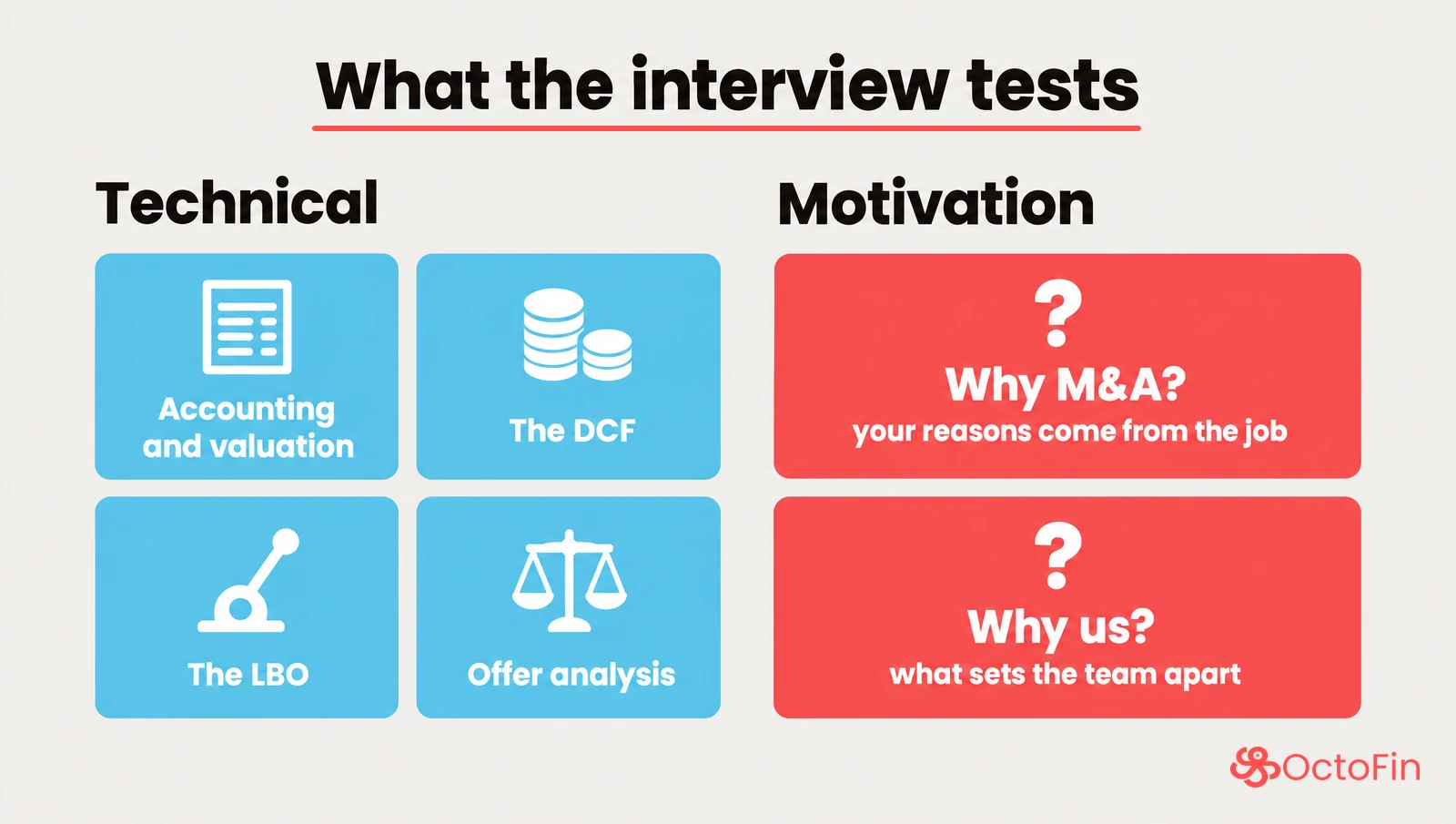
Processes differ from one firm to the next. Rothschild & Co's Paris Large Cap offer, still online on November 16, 2026, invites shortlisted candidates to a first round of interviews during a recruitment morning, on November 13 or November 20 (the offer doesn't give the year); Lazard's Paris offer only says it will get in touch about next steps. What's tested, though, comes back in the same families:
- Accounting and valuation. The three statements and how they link, the bridge from enterprise value to equity value, multiples and comparables. Rothschild & Co's Paris offer asks for solid financial and accounting knowledge. Our investment banking interview questions cover these blocks with answers written to be said out loud.
- The DCF. "Walk me through a DCF" is prepared step by step, with numbers: see our walk me through a DCF answer and its full example.
- The LBO. Funds are among the buyers an M&A analyst deals with, as offers A and C show. Practice on a paper LBO example worked through by hand, with a pen and no Excel.
- Offer analysis. Redo this page's example without looking, all the way to the ranking and the spoken summary. It draws on the bridge, multiples and judgment about conditions.
- "Why M&A?" The interviewer checks that you know what the job really is (mandates, documents, models, a process to run until closing) and that your reasons come from the job itself.
- "Why us?" The interviewer checks that you've looked at what sets the team apart. The offers give you concrete hooks: Lazard's Generalist team working on large deals across Europe, Rothschild & Co's M&A sector teams in London, the mid-market focus of Crédit Agricole Midcap Advisors. Add what the people you've met told you.
After the M&A analyst years: exit opportunities
The sources read for this page give no dated, sourced breakdown of where analysts go next, so here are the paths without ranking.
- Moving up. DealRoom describes the ladder as analyst, associate, vice president, senior vice president or director, then managing director, with execution giving way to origination as you rise.
- Staying after the internship. As seen above, at the end of Rothschild & Co's two London internships, the intern can be considered for its Graduate Programme (if it goes well, adds the CEE offer); JPMorgan writes that high-performing analysts may be able to move into a range of roles within the firm.
- Private equity. M&I describes the analyst job as a two- to three-year stint, followed by promotion or a move to private equity, hedge funds, venture capital or corporate development; DealRoom names private equity and corporate development as the two main exits. Funds are also clients and buyers: offers A and C above come from funds. The job on the fund's side is described in our guide on how to get into private equity, and its interview in our private equity interview questions.
- Corporate development. The in-house M&A team described above, which DealRoom presents as the other main exit.
Frequently asked questions
What is an M&A analyst?
An M&A analyst is the entry-level banker on a team that advises companies and their owners on mergers, acquisitions and sales. Day to day, that means valuation models, pitch materials, the teaser and information memorandum, buyer lists, the data room and the analysis of offers, as the offers, testimonials and guides quoted on this page describe it. It's different from an M&A role in a company's corporate development team, which buys and sells businesses for its own group.
How much do M&A analysts make?
We don't give a figure, on purpose. The bank program pages we opened, JPMorgan's and Piper Sandler's, publish none. The career guides that do give ranges, such as M&I and DealRoom, publish estimates, their own or taken from another guide, rather than figures published by the banks; DealRoom's guide, updated on October 21, 2026, also shows three different total compensation ranges for the same New York analyst in different sections. Pay depends on the bank, the city, the year and the bonus; M&I notes it's lower outside the US, London included, and tends to be lower at boutiques. The figure to trust is the one written in the job posting or the offer letter itself.
Is M&A a stressful job?
Often, according to the sources on this page. M&I's DeChesare calls the hours bad, describes being on call at all times with urgent requests, and says banks' "protected weekends" and mandatory time off have had mixed results. Vincent B., at Crédit Agricole Midcap Advisors, describes an intense marketing phase and a pace that speeds up toward closing; Piper Sandler warns that you may travel at short notice. The same testimonial adds that staff at Crédit Agricole Midcap Advisors are judged on the quality of their work, not on nights spent at the office. We don't give hours: the figures in circulation are estimates.
Who are the big 4 in M&A?
The question mixes two worlds. "Big Four" is, in the words of the UK's Competition and Markets Authority (2019 audit market study), the "collective term for the four largest audit firms: Deloitte, EY, KPMG and PwC". They aren't investment banks, but they do deal work: PwC UK's Deals practice, for example, offers lead advisory on buying and selling businesses and raising capital, alongside transaction services and restructuring. Career guides treat Big Four transaction services as a way into M&A: DealRoom lists it among the entry routes, and M&I mentions a Big 4 firm as a related first job before a lateral move. If you meant the largest M&A advisers by deal value, that's a league table question, and league tables depend on the year and on the data provider: look at a current, dated one.
What is the difference between a merger and an acquisition?
In a merger, one corporation is absorbed into another, according to the definition of the Legal Information Institute at Cornell Law School. Under Delaware corporate law, for example (8 Del. C. § 259(a)), the absorbed corporation stops existing separately, its property vests in the surviving corporation, and its debts and liabilities attach to it. In an acquisition, the buyer purchases a controlling stake, or all the shares, of a company to take it over; both companies remain separate entities, one controlling the other. This page's worked example is an acquisition: the founder sells the shares for a price.
Keep practicing
An M&A analyst interview is prepared by doing: the bridge, multiples, the DCF and the LBO have to come without effort. In OctoFin, 11 chapters and 57 lessons cover, among other things, accounting, the DCF, the Merger Model and the M&A process; more than 1,000 practice questions come as flashcards, multiple-choice or open-ended prompts; and more than 1,300 real interview reports show you what banks actually ask. Plans and pricing are on the home page: see pricing. OctoFin doesn't offer one-to-one coaching: for a mock interview with a banker, a human coach is the better fit.