
How to Get Into Private Equity: the 5 Paths In, the Internship, the Interview and the Job
- Private Equity
- Careers

How to get into private equity? Most people join a fund as an associate after two or three years as an investment banking analyst or a consultant, according to the Growth Equity Interview Guide; some funds, mostly large ones, also hire analysts straight out of university, and others recruit from MBAs or operations roles. Below: the five paths in, each with its source, how recruiting works (on-cycle, off-cycle, headhunters), the internship, one European fund's interview process, then the job itself, from analyst to partner, and a mini LBO seen from the fund's side.
Wondering how to get into private equity, and where to start? This page puts first what decides your chances: the paths in, how funds recruit (on-cycle, off-cycle, headhunters), the internship, and the interview process, including the real process of one European fund, as its HR director describes it. Then comes the job itself: how a fund works, the strategies, the titles from analyst to partner, what an analyst does on a deal, and a mini LBO worked out from the fund's side, to see where the return actually comes from.
Every fact comes from a source named in the text. Where the sources disagree, you'll see both views. You won't find salaries or hours here: the guides we read give estimates without citing a primary, dated source.
How to get into private equity: the short answer
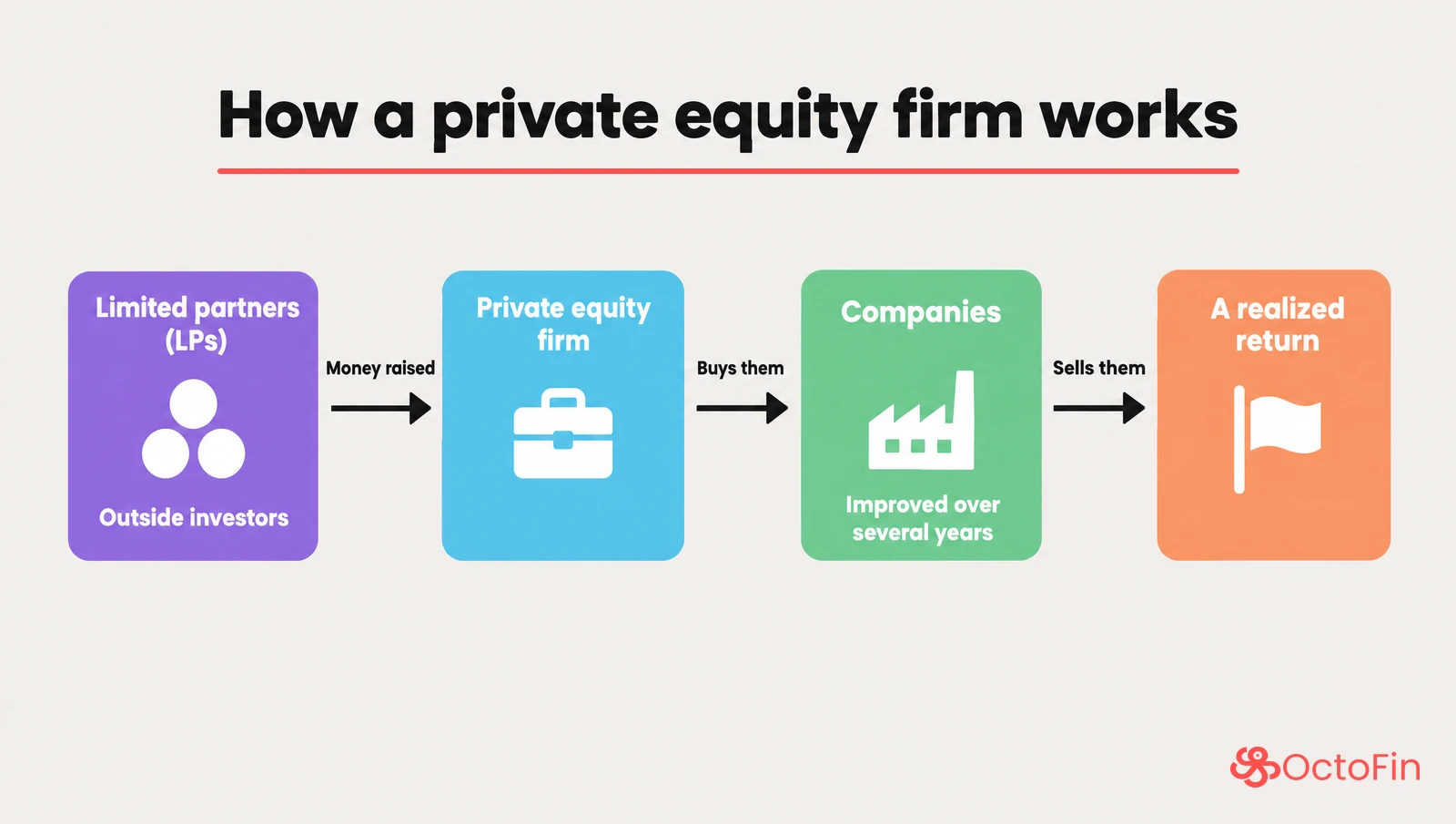
Private equity firms raise money from outside investors, called limited partners (LPs), use it to buy companies, improve them over several years, then sell them to realize a return: that's how Mergers & Inquisitions (M&I), a US finance careers site, sums up the business. The firm's investment team, from analyst to partner, finds those companies, decides whether to buy, and works with them until the sale.
As for the way in, most people start their private equity career at the associate level, after a few years of investment banking or management consulting, according to the Growth Equity Interview Guide (GEIG, updated in May 2025), written by Mike Hinckley, who presents himself as an investor at General Atlantic; his resume checklist for those candidates asks for two or three years at a top bank or consulting firm. Some funds, mostly large ones, also hire analysts straight out of university. Others take people from consulting, from an MBA or from operations roles. Those are the five paths below, each with what its sources say.
The 5 paths into private equity
| Path | Who it suits | What the sources say | Sources |
|---|---|---|---|
| 1. Investment banking analyst, then pre-MBA associate | Students who can land an investment banking analyst offer | The route most people take: two or three years in banking, then an associate role; large funds hire from bulge-bracket and elite boutique banks, smaller funds from middle-market and boutique banks | GEIG, CFA Institute, M&I, Bright Network |
| 2. Straight from university, as an analyst | Students from top schools with several finance internships | Offered by many mega-funds and some upper-middle-market funds; in Europe, M&I names Terra Firma, 3i, Ardian and PAI; unusual for graduates, according to Bright Network, a UK careers network; A Simple Model advises banking first | M&I, Bright Network, A Simple Model, GEIG |
| 3. Consulting | Top performers at top management consulting firms | Possible after entry-level consulting; some funds only want bankers; much harder after the associate level | GEIG, Bright Network, A Simple Model |
| 4. MBA or mid-career | Career changers, ideally with some investing experience | Rarer; easier with buy-side experience before the MBA; aim for smaller middle-market funds | GEIG, CFI, Bright Network |
| 5. Operations, transaction services, corporate development | People from diligence, operations or finance roles | Many enter after transaction advisory, accounting or corporate development (CFI); an operations role inside a fund gets you in, usually with less upward mobility (GEIG); transaction services profiles are highly valued at one small-cap fund | CFI, GEIG, France Invest |
M&I is more restrictive than this table. It counts three pathways only: straight from university as an analyst, from investment banking, and being hired away from another private equity firm. Outside those three, it calls a hire by a US or UK firm very unlikely, and says it's more feasible for non-bankers in other markets, naming Russia, India, Central and Eastern Europe and Portugal. The other guides are more open. Here's what each path involves.
1. Investment banking analyst, then associate: the path most people take
GEIG calls investment banking by far the most common training ground for private equity. CFA Institute, the body behind the CFA exams, writes that private equity firms usually look for entry-level associates with at least two years of experience in banking. M&I specifies where funds look: large firms target analysts at bulge-bracket and elite boutique banks, while smaller firms may hire analysts from middle-market and boutique banks.
In the UK, Bright Network, a graduate careers network, gives the same advice: get into an investment bank, excel in your first few years as an analyst, and network, because most private equity firms use headhunters to recruit top candidates from the banks. GEIG explains why the detour pays: banks are bigger than funds, so they have more jobs to offer, and they give you experience that will serve you well in private equity. "Pre-MBA associate" simply means an associate hired before any MBA, usually straight from banking or consulting.
On this path, the first offer to win is the banking one. Our investment banking interview questions cover the technical classics, and the valuation question has its own page: walk me through a DCF.
2. Straight from university, as a private equity analyst
M&I's page on the role (first published in 2019, updated in September 2026) describes private equity analysts as people hired straight out of undergrad or a non-MBA master's program, with little or no full-time work experience, often in roles that aren't on the track to partner. Its examples of firms offering the role: many mega-funds and some upper-middle-market funds, such as Blackstone, KKR and Carlyle. In Europe, it writes, some of those firms, as well as firms like Terra Firma, 3i, Ardian and PAI, offer analyst roles. M&I's recruitment page adds that these roles are increasingly common at mega-funds and upper-middle-market funds.
What M&I says it takes: a top target school, or at least one of the top 20 or so universities; extensive internship experience; and networking, because firms don't openly advertise many of these positions. GEIG adds high grades and leadership roles, and notes that analyst work is mostly sourcing (cold-calling companies, researching leads), so finance and sales experience both help. Its tip: a strong internship the year before you graduate is a great way to a full-time analyst offer.
The sources disagree on whether it's a good idea:
- M&I: only if you're sure you want private equity for the long term, the fund is well known, you'll do real work rather than cold calling, and there's a chance of promotion to associate. The downsides it names: a smaller network, less training and a weaker brand name than a bank.
- A Simple Model, a financial modeling training site, warns that many newer, smaller funds don't close enough deals, or have the resources, to train an entry-level analyst. Its advice: put in your hours at a bank first, unless the fund will train you and closes deals regularly, at least one a quarter.
- Bright Network, which writes for UK graduates, says most private equity firms don't recruit out of university, so starting there as a graduate is unusual; a few firms do, usually through summer analyst programs.
3. From consulting
GEIG writes that you can recruit for private equity after entry-level consulting, especially as a top performer at a top management consulting firm. Some funds only want investment bankers, but many are open to consultants, because many top graduates go into consulting. Moving from consulting into investing gets much harder after the associate level. Bright Network also lists management and strategy consulting as a route in. Mary Reed, a contributing writer at A Simple Model who worked at McKinsey and American Securities, adds that mega-funds hire associates out of consulting.
4. After an MBA, or mid-career
GEIG calls this a rarer path than the entry-level ones. It's much easier if you did some buy-side investing before business school. Its advice to mid-career candidates: go to a top 10 business school, target the right kind of firm (typically a small, relatively new middle-market fund open to your background), stay flexible on the level of role, pile up internships during the MBA, and network hard. CFI (Corporate Finance Institute, a finance training company) notes that top business schools are a common pipeline for post-MBA associate roles at larger firms. Bright Network, writing for UK graduates, adds a caveat: even funds that hire MBAs usually want a couple of years of prior investment banking.
Mary Reed describes the odds of reaching a mega-fund without a banking background as U-shaped: much higher very early or very late in a career, and close to zero in between.
5. Through operations, transaction services or corporate development
CFI writes that many professionals enter private equity after experience in investment banking, management consulting, transaction advisory, corporate finance, accounting or corporate development. Some join the operations or portfolio group, which works with portfolio companies on the value creation plan; CFI says that team suits backgrounds in consulting, operations or senior finance. GEIG's warning: an operations role gets you in the door of a private equity firm, but usually without the same upward mobility as the investing track.
One European fund names transaction services as a good preparation. On the recruitment page of France Invest, the French private equity association, Sandra de Oliveira, HR director of 123 Investment Managers (123 IM), an asset manager authorized by France's AMF since 2001, which she describes as a small-cap fund, is asked which prior internships help most. Her answer: at her fund, profiles from transaction services (the financial due diligence teams of audit and advisory firms) are highly valued, because they know how to read an income statement and where to look for information. She also cites bridges for engineering and accounting profiles.
How private equity recruiting works: on-cycle, off-cycle and headhunters
Two kinds of process coexist. Which one you face depends on where you apply, at what level, and where you work today.
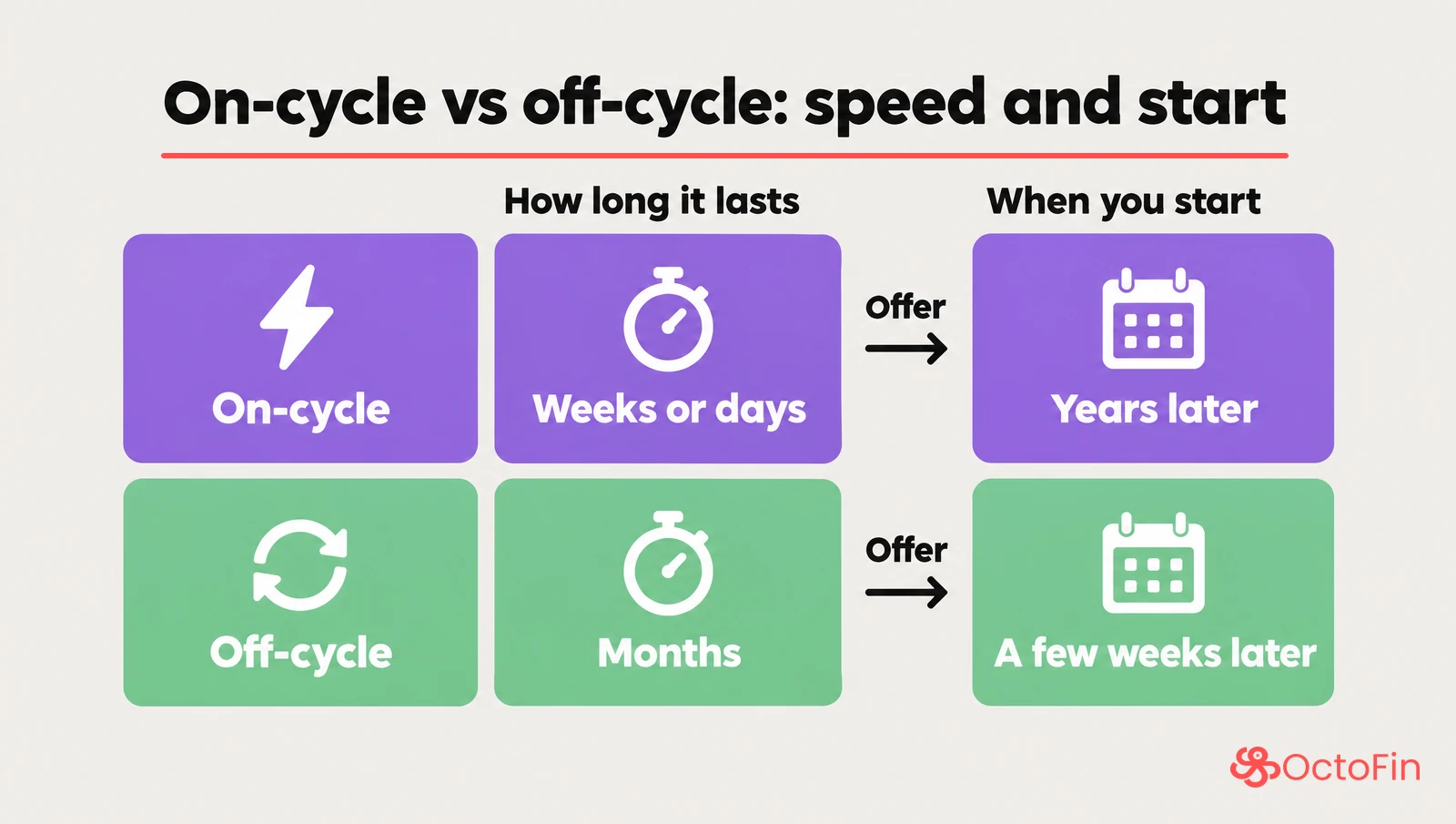
| On-cycle | Off-cycle | |
|---|---|---|
| Who it's for | Pre-MBA associate roles at most large US firms (GEIG); analysts at bulge-bracket and elite boutique banks in New York (M&I) | Everyone else: roles outside New York or in other countries, at smaller firms, or for candidates outside banking (M&I); most smaller US firms and most European and Asian firms (GEIG) |
| When it starts | Within a few months of the analyst's start date at the bank, or even before (M&I), and earlier every year (GEIG) | Throughout the year, as needs arise (GEIG) |
| How long it lasts | A frenzy of 2 to 3 weeks; some firms finish in 2 to 3 days (GEIG) | Months rather than weeks or days (M&I) |
| When you start the job | 1.5 to 2 or more years after the offer (M&I) | Within a few weeks of the offer (M&I) |
| What's assessed | A few days of intense interviews, case studies and discussions (GEIG) | Fit and critical thinking, in more depth (M&I) |
If you're aiming for Europe, GEIG puts most European firms in the off-cycle camp: they hire when they need someone. That means two things, it notes: you have to be findable, with a professional online presence recruiters can see, and you have more room to reach out to funds yourself. Our private equity interview questions page compares the processes described for New York, London and Paris.
Headhunters. Not every private equity firm uses them, GEIG writes, but many (most) do. When they're involved, they run the initial search and the screening interviews: they're the gatekeepers. For on-cycle, GEIG says you apply or get approached by a headhunter before the process starts, and have a first screening interview with them. Its advice for getting on their radar: LinkedIn, and above all an introduction from someone who has worked with the recruiter. Bright Network describes the same mechanism in the UK: most firms use headhunters to recruit top candidates from investment banks.
Networking. M&I notes that firms don't openly advertise many analyst positions. Bright Network suggests starting with your university's alumni: find someone in the job you want, ask politely for a short video call, prepare your questions and thank them. A Simple Model tells candidates with nontraditional backgrounds to network aggressively and expect to hear "no" a lot: few people persist, and that's the advantage.
The private equity internship
Where they exist. M&I writes that some private equity firms hire summer interns and then extend full-time return offers, while others try to pick off interns from the top banks; some offer summer internships but don't hire full-time out of undergrad. GEIG's warning for students: most full-time roles are filled by interns who impressed the firm the previous summer, so keep the internship recruiting timeline in mind, not just the full-time one. In the UK, Bright Network says the few firms that recruit from universities usually do it through summer analyst programs, where undergraduates work full-time over the holidays, with intense competition for places.
What you'll do. According to 123 IM's HR director, an intern does exactly what the analysts do: you're paired with an associate or an analyst and work alongside them on every stage of their deals. At a fund that works this way, the section on what an analyst does, further down, describes your internship too.
Which internships before. CFI lists investment banking, private equity, transaction advisory, valuation, consulting and corporate development. At 123 IM, as seen above, transaction services profiles are highly valued. GEIG's general advice: get the best internships you can, as early as you can.
How to apply. 123 IM's HR director advises sending your resume and a cover letter, and repeating a few lines of motivation in the body of the email.
The private equity interview process
The process GEIG describes
GEIG lays out a generic process, mostly for associate roles:
- A screening interview with the headhunter, when the firm uses one.
- Several interviews with members of the firm. In on-cycle, several on the same day.
- A mix of questions: fit (GEIG cites "why private equity?" and "why our firm?" among the big ones), behavioral, and technical.
- A case study, required for most associate-level roles. You get materials on a potential investment (past investment committee memos, public filings or a confidential information memorandum) and one question: would you invest? You usually back your answer with an LBO model and a memo or slides. GEIG describes two formats: a live test of 2 to 4 hours, common in on-cycle, or a take-home case of 2 to 7 days, followed by a discussion.
- A paper LBO, at associate level or higher: a simplified LBO done with pencil and paper, usually in 20 minutes at most, and sometimes purely out loud.
At the analyst and intern level, M&I says the emphasis shifts: less on deal experience, and case studies that, when they come up, probably won't be as detailed as for associates. Interviews focus more on why you want private equity straight out of university and how it fits your long-term goals. GEIG adds that some firms lower their LBO expectations for undergrads and consulting hires, but recommends preparing anyway, since the model can be learned.
The process at one European fund: 123 Investment Managers
On France Invest's recruitment page, Sandra de Oliveira, HR director of 123 IM, describes her fund's typical process:
- A meeting with two members of the team; for a junior role, they're associates (chargés d'affaires, in French).
- A second meeting, with a one-hour case study.
- Right after, a meeting with an HR representative.
- A meeting with at least 3 or 4 people from the team, to make sure you can fit into the firm's culture.
It's one fund's process, described by its HR director, not a norm: there's no headhunter in it, and the case lasts one hour where GEIG describes 2 to 4 hours live or several days at home. On preparation, she's specific: learn about the job, the firm's structure, its investment thesis and examples of its investments. And she adds that motivation is often valued more than skills.
What to prepare
| Block | What the interviewer checks | How to prepare |
|---|---|---|
| Your motivation | That you know what the job is, and why this fund | Follow 123 IM's list: the job, the firm's structure, its investment thesis, its past investments |
| Your story | The thread from your internships to investing | For each experience: one precise task, one result, what it taught you about investing |
| Technicals | That you can read accounts and value a company | Accounting and valuation in our investment banking interview questions; the mechanics of a buyout in what is an LBO |
| The paper LBO | That you can get to a return by hand | Redo our paper LBO example, then its second deal without looking at the solution |
| The case | That you reason like an investor, up to a decision | End every practice case with "I'd invest" or "I'd pass", with a price and the main risk |
| A portfolio company | Your judgment: an argued view, not a summary | Pick one company the fund owns: why it invested, what can create value, what can go wrong |
"Why private equity?"
GEIG lists it among the big fit questions, along with "why our firm?". A good answer starts from something you actually did, such as the moment you wanted to make the call rather than advise on it, and lands on this fund's strategy: 123 IM's HR director, for her part, tells candidates to study the fund's investment thesis before the interview. The full answer, with its structure and the mistakes to avoid, is in our private equity interview questions.
What a private equity firm does: LPs, GPs and the life of a fund
The investors in a fund are the limited partners; CFA Institute calls the private equity firms themselves the general partners (GPs). France Invest lists who the LPs usually are: pension funds, insurers, banks, funds of funds, public bodies and large companies. CFI adds endowments and high-net-worth individuals. According to France Invest, these funds are raised for a fixed term, often 8 to 12 years, with an investment phase, a holding phase and an exit phase. With the fundraising that comes first, that makes four stages.
| Stage | What happens | What the team does |
|---|---|---|
| 1. Fundraising | The firm collects commitments from its LPs. | Partners own the LP relationships; the investor relations team prepares the fundraising documents and answers investors' due diligence questionnaires (France Invest, CFI). |
| 2. Investing | During the investment period, the fund looks for companies and buys stakes in them. France Invest describes several months between the first meetings and the closing, with audits, negotiations and legal agreements. | The investment team sources targets, analyzes them, runs due diligence with the fund's advisers, and presents each deal to the investment committee. |
| 3. Holding | The fund works alongside management as a co-pilot, without running the company; France Invest calls the strategic committee the heart of the dialogue with the fund. | The team tracks results, values the portfolio and pushes the value creation plan; at some firms, an operations team helps (CFI). |
| 4. Exit | The fund sells its stake. France Invest and Grant Thornton's study sorts these sales by buyer: other private equity firms, management, industrial (trade) buyers, IPOs and others. An example from France: the average holding period of companies sold by French private equity firms was 7 years in the first half of 2026 (France Invest and Grant Thornton, study published on October 13, 2026). | The team prepares the sale and calculates the final return: MOIC and IRR. |
Some investors have no LPs: evergreen vehicles and family offices invest their own money, with no fixed term (France Invest).
Private equity strategies
CFI lists five common types of private equity. Here are four of them, with what the analyst looks at first in each.
| Strategy | What the fund finances, according to CFI | What the analyst looks at first |
|---|---|---|
| Venture capital | Early-stage or high-growth companies with significant upside | The market, the product and the team: France Invest writes that venture funds bet on the vision and the team |
| Growth equity | Established companies that want to expand, launch new products or enter new markets | The growth plan, and what the money will pay for |
| Leveraged buyouts (LBOs) | A controlling stake in a company, often with debt as part of the financing | The company's ability to repay the debt: that's what the LBO model tests |
| Distressed investing | Companies facing financial stress, often with the goal of restructuring them | Cash, and the turnaround plan |
The fifth, mezzanine financing, provides capital that mixes features of debt and equity, often for acquisitions or expansion (CFI).
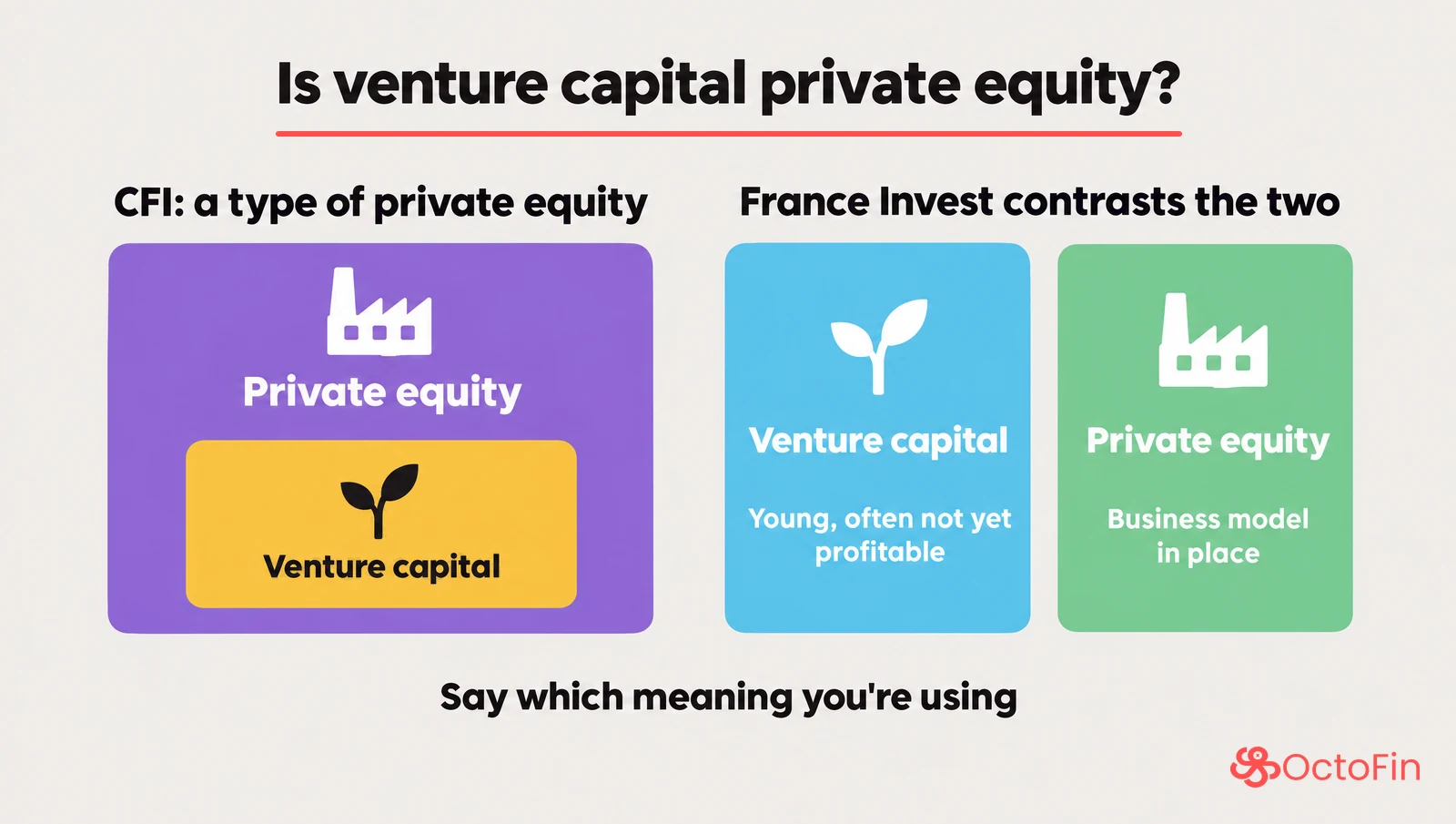
Watch the word itself. CFI counts venture capital as a type of private equity. France Invest, in its guide for entrepreneurs, contrasts the two instead: venture capital for young, innovative companies that are often not yet profitable; private equity once the business model is in place. In an interview, say which meaning you're using.
The private equity career path: from analyst to partner
M&I gives a representative hierarchy, while stressing that it varies from firm to firm. The roles below combine its descriptions with CFA Institute's.
| Title | What the role does |
|---|---|
| Analyst | The entry level: specific tasks such as reviewing data (CFA Institute), models, research and logistics on deals; often hired from university, in many cases in roles that aren't partner-track (M&I) |
| Associate (pre-MBA) | Deal work and analysis (M&I), usually after two or three years in banking or consulting (GEIG) |
| Senior associate | More independence: sees a deal through from start to finish and starts generating ideas (CFA Institute) |
| Vice president | Manages the deals (M&I); more relationships and presentations, less data work, and manages and mentors associates (CFA Institute) |
| Director or principal | Generates and negotiates deals (M&I); in charge of fundraising, and handles the final negotiations (CFA Institute) |
| Managing director or partner | Brings in deals, raises funds and represents the firm (M&I); convinces LPs to commit capital, and puts part of their own wealth into the firm (CFA Institute) |
The split of the work follows seniority. M&I sums it up: senior people focus on fundraising, sourcing deals, representing the firm and making the final investment decisions; junior people, analysts and associates, on executing deals, monitoring portfolio companies, and generating and screening new deals. Titles vary too: M&I notes that some firms use "analyst" and "associate" interchangeably, and even advertise "analyst / associate" roles.
Around the investment team, a private equity firm has other careers. CFI describes the operations or portfolio group, investor relations, which manages the relationship with LPs and supports fundraising, and finance and accounting, which handles fund reporting, capital calls and distributions. When a job ad says "analyst", check which team it's for.
What does a private equity analyst do?
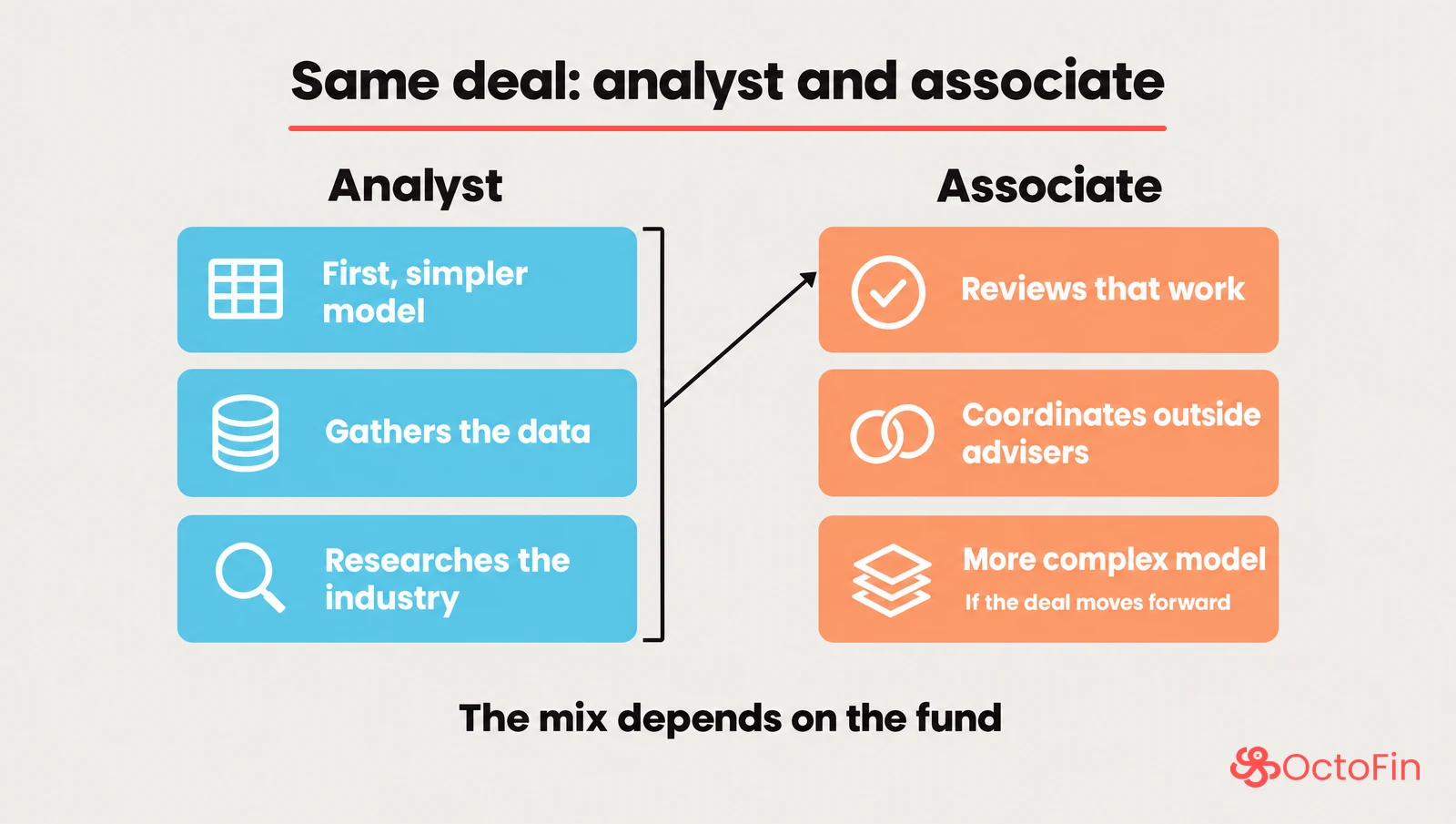
M&I lists the core tasks of a private equity analyst: building financial models, reviewing the confidential information memorandums (CIMs) that bankers send when they sell a company, monitoring portfolio companies, doing due diligence on potential investments, and cold calling to source new deals. The mix depends on the fund. At a mega-fund, the analyst does more of the modeling and data work; at a middle-market fund with a flatter structure, the analyst may act more like an associate. On the same deal, M&I adds, the analyst might build the first, simpler model, gather the data and research the industry, while the associate reviews that work, coordinates the outside legal and accounting advisers and builds the more complex model if the deal moves forward.
Here's the work in the order of a deal:
| Stage of the deal | What the analyst does | Sources |
|---|---|---|
| 1. Sourcing | Cold calls companies and bankers, reads teasers and business descriptions, signs confidentiality agreements, researches sectors to screen out poor fits | M&I, A Simple Model, GEIG |
| 2. First look | Reviews the CIM, builds a first, simpler model, gathers data, researches the company and its competitors | M&I, CFI |
| 3. Due diligence | Updates the LBO model as new projections arrive, normalizes EBITDA, runs sensitivities on the purchase price, leverage, exit multiple, growth and margins; joins management presentations and calls with lenders and experts | CFI, M&I |
| 4. Investment committee | Drafts the investment committee materials with the associate | M&I, CFI |
| 5. Portfolio | Updates the internal model with each portfolio company's results, drafts reports, works on add-on acquisitions | M&I |
M&I's verdict on the day-to-day: the tasks aren't that different from an investment banking analyst's, but expectations are higher, there's less hand-holding, and more judgment is required. And the job doesn't stop at the purchase. Rémi Viel, a managing director at Eurazeo, quoted on France Invest's page, describes his team's time as about 60% spent as a sparring partner to the management of portfolio companies, and 40% meeting entrepreneurs and spotting promising sectors. That's one team's split, not a norm, but it shows how much of the job happens after the deal closes.
A mini LBO from the fund's side: where the return comes from
In a buyout, the LBO model is the analyst's core tool. Here, in six lines, is what it calculates for the investment committee: how much the fund puts in, how much it gets back, and where the difference comes from. The numbers are round, in millions of dollars ($m), so you can check everything in your head. GEIG notes that an LBO model usually assumes a five-year hold; so does this one.
The assumptions
- Last twelve months' EBITDA: $20m.
- Purchase price: 8x EBITDA.
- Debt: 4x EBITDA. Each year, the company repays $8m with the cash left after interest, tax and capex (a simplifying assumption: a fixed amount).
- EBITDA grows from $20m to $30m over 5 years.
- Exit after 5 years, at the same multiple as at entry: 8x year-5 EBITDA.
- No fees; the deal is cash-free, debt-free.
- The fund targets a 20% IRR.
The six lines
| Line | Calculation | $m |
|---|---|---|
| 1. Entry price (enterprise value) | 8 × 20 | 160 |
| 2. Debt raised for the buyout | 4 × 20 | 80 |
| 3. The fund's equity check | 160 − 80 | 80 |
| 4. Enterprise value at exit | 8 × 30 | 240 |
| 5. Debt left at exit | 80 − 5 × 8 | 40 |
| 6. What the fund gets back | 240 − 40 | 200 |
MOIC: 200 / 80 = 2.5x. IRR: 2.5^(1/5) − 1 ≈ 20.1%.
To check it without a calculator, start from 1.2: 1.2 × 1.2 = 1.44; 1.44 × 1.44 ≈ 2.07; 2.07 × 1.2 ≈ 2.48, or 2.49 without rounding along the way (1.2⁵ ≈ 2.488). An investment that earns 20% a year is multiplied by 2.49 in 5 years: 2.5x in 5 years is an IRR of just over 20%.
Where the gain comes from
The fund put in 80 and gets back 200: a gain of $120m. Break it down.
| Lever | Calculation | $m | Share |
|---|---|---|---|
| EBITDA growth | (30 − 20) × 8 | 80 | two-thirds |
| Change in the multiple | (8 − 8) × 30 | 0 | none |
| Debt paydown | 80 − 40 | 40 | one-third |
| Total | 200 − 80 | 120 | 100% |
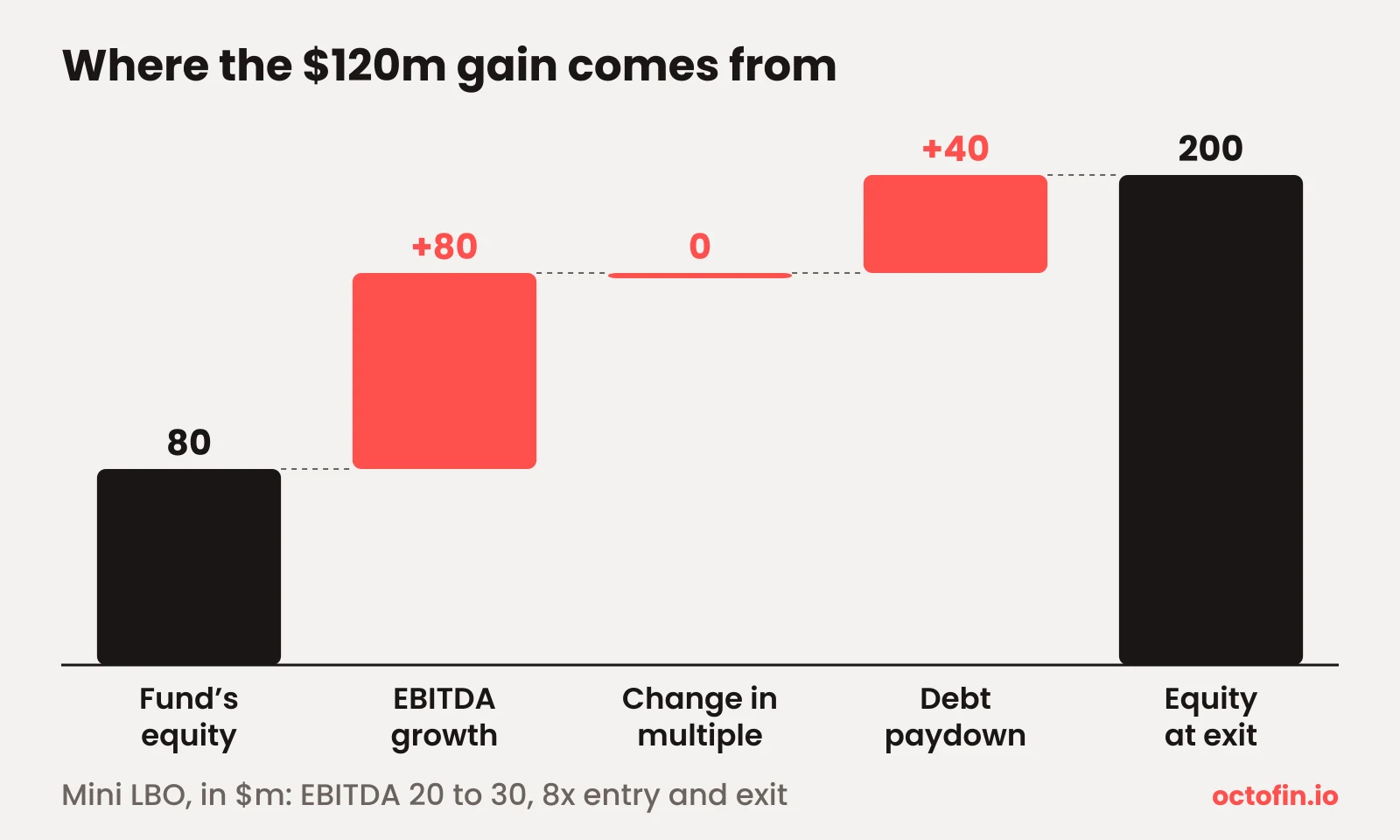
Now compare the two increases. At exit, the company is worth 1.5 times its entry value: 240 / 160 = 1.5. The fund's stake, meanwhile, is multiplied by 2.5. That's leverage at work: the fund paid only half the price, and it collects all of the increase in value (80) plus all of the debt repaid (40), because the lenders only get back what they're owed.
The committee's questions
The committee doesn't stop at the base case. It tests what can go wrong.
| Question | Calculation | Answer |
|---|---|---|
| "What if we sell at 7x?" | 7 × 30 = 210; 210 − 40 = 170; 170 / 80 = 2.125x | IRR ≈ 16.3%: below the target |
| "What's the lowest exit multiple that still gets us 20%?" | 1.2^5 = 2.48832; 80 × 2.48832 ≈ 199.07 of equity; 199.07 + 40 = 239.07 of enterprise value; 239.07 / 30 ≈ 7.97x | About 7.97x: almost exactly the 8x paid |
| "What if the exit takes 7 years, the average holding period France Invest and Grant Thornton measured in France in the first half of 2026?" | Same MOIC (the same 200, two years later): 2.5^(1/7) − 1. If the company keeps repaying 8 a year and EBITDA stays at 30: 7 × 8 = 56 repaid; 80 − 56 = 24 of debt left; 240 − 24 = 216; 216 / 80 = 2.7x; 2.7^(1/7) − 1 | ≈ 14.0% at the same MOIC; ≈ 15.2% if repayments continue: both below 20% |
What the analyst writes in the memo: 2.5x and about a 20% IRR, right on target, but no margin of safety. Two-thirds of the gain depends on EBITDA growing 50%: that's the business plan to test in due diligence. The fund has to sell at roughly the multiple it paid, or more, and every extra year of holding costs IRR, even at the same MOIC.
This mini LBO skips a step: getting from EBITDA to the cash that repays the debt (interest, tax, capex, working capital). For the full exercise, with every table, the interviewer's follow-ups and a second deal to solve on your own, go to our paper LBO example, solved step by step. For the structure of the deal itself (the holding company, the debt, why leverage cuts both ways), see what is an LBO.
Frequently asked questions
Is it difficult to get into private equity?
Yes: M&I, GEIG, CFA Institute and Bright Network all say so. M&I writes that there are relatively very few private equity roles and that firms follow very narrow hiring criteria; GEIG calls it one of the most competitive jobs to get, in finance and beyond; CFA Institute also points to the small number of jobs. None of them backs a success rate with data, so we don't give one. What you control: picking the path that matches where you are now, and preparing your technicals and a view on each fund well before the process starts, since an on-cycle process can be over in a few days (GEIG).
How do you get into private equity with no experience?
The sources disagree. CFA Institute says that coming into private equity with no experience is impossible, and recommends an internship or prior experience in a related field. GEIG sees two paths for people with no finance experience: aim for an analyst role while you're still at university, or, mid-career, accept so much work and sacrifice that, in his words, most people are unwilling to do it. For how to break into private equity with a nontraditional background, A Simple Model gives three pieces of advice: show what you can add from day one rather than saying you'll do anything, network aggressively, and train yourself in modeling before you're hired. The indirect routes, through transaction advisory, accounting or corporate development, are path 5 above (CFI).
What does a private equity analyst do?
A private equity analyst builds the financial models, reviews the information memorandums that bankers send, does due diligence, monitors portfolio companies and, at many funds, sources deals by cold calling (M&I). At a mega-fund, the role leans toward modeling and data; at a flatter middle-market fund, it's closer to an associate's. The section on what a private equity analyst does, above, goes through it stage by stage.
Is private equity a high-paying job?
M&I and Bright Network say so: M&I names high compensation first among the reasons people are drawn to private equity, and Bright Network says the roles tend to be well paid, depending on the role, the firm and the location. But the figures they give are estimates without a primary, dated source, so we don't repeat them. One nuance from M&I: private equity analyst roles straight out of university usually pay less than investment banking analyst roles, partly because of where the money comes from (management fees on committed capital in private equity, deal advisory fees in banking).
Can you get into private equity without investment banking?
Yes, according to most of the sources on this page, which describe four other paths: straight from university as an analyst (M&I), from consulting (GEIG, Bright Network), after an MBA (GEIG, CFI), and through operations, transaction services or corporate development (CFI, GEIG, 123 IM's HR director). M&I is more cautious: outside its three pathways, it calls a hire by a US or UK firm very unlikely. And Mary Reed, at A Simple Model, puts the odds of reaching a mega-fund without banking highest very early or very late in a career. The table of the five paths, at the top of the page, sums up who each one suits.
Keep practicing
A private equity interview is prepared like a deal: technicals that no longer cost you any effort, and a view on the fund in front of you. OctoFin's lessons (11 chapters, 57 lessons) take you from accounting and valuation through the DCF and LBOs to the Merger Model; its Practice module holds more than 1,000 questions, and you can read more than 1,300 reports from real interviews. OctoFin doesn't publish their split by country or type of firm: if you're targeting funds in New York or London, check they're covered before you count on them. The home page sets out our plans: see the pricing section. And for a mock interview with a professional, go to a human coach: OctoFin doesn't offer one.