Investment Banking Interview Process: the 6 Steps From Application to Offer, What Each Round Tests and How It Differs in New York, London and Paris
- Recruiting
- M&A
The investment banking interview process almost always runs in six steps: an online application, online tests or a recorded video interview, a first interview, interviews with the team, a final round (a superday, or an assessment centre in London) and the offer. Below: what each round tests, what banks such as Goldman Sachs, J.P. Morgan, Morgan Stanley and Rothschild & Co write about their own process, how New York, London and Paris differ, and what 1,128 interview reports on OctoFin show about the rounds.
The investment banking interview process tends to intimidate more than it surprises. From one bank to the next, the names change and the order shifts a little, but the mechanics stay the same: a screen on your application, online tests or a recorded video interview, then a series of increasingly demanding interviews, up to a final round and the offer. Goldman Sachs even numbers its own steps on its student careers page, from submitting your application to the superday.
This guide is for students targeting an M&A internship or analyst role in New York, London or Paris. It walks through the six steps of the process, what each round really tests and how to prepare for it, how the process differs by city, and what 1,128 interview reports shared on OctoFin say about the rounds. Every fact about a bank comes from a named source, read on November 16, 2026: bank careers pages and job offers first, then two well-known recruiting guides.
The investment banking interview process at a glance
| Step | What happens | What it tests | What a bank writes about it |
|---|---|---|---|
| 1. Application | Online form: resume, often a cover letter | A clear story, genuine motivation | Rothschild & Co: no edits to your resume or cover letter once submitted |
| 2. Online tests or video | Reasoning tests, a recorded video interview | Rigor, time management, first impression | J.P. Morgan: no further review until the HireVue video interview is done |
| 3. First interview | A video, phone or in-person screen | A consistent profile | Goldman Sachs: a video interview of about 30 minutes |
| 4. Team interviews | One or more rounds with bankers, sometimes a case study | Technical basics and fit | Blanche Capital: a case study and an interview with an analyst, 2 hours in all |
| 5. Final round | A superday, or an assessment centre in London | Consistency over a full day | Goldman Sachs: two to five interviews for campus hires, depending on the division |
| 6. Offer | The bank's answer and, if positive, the offer | Nothing more: now you choose | Rothschild & Co: the offer is subject to immigration approval before your start date |
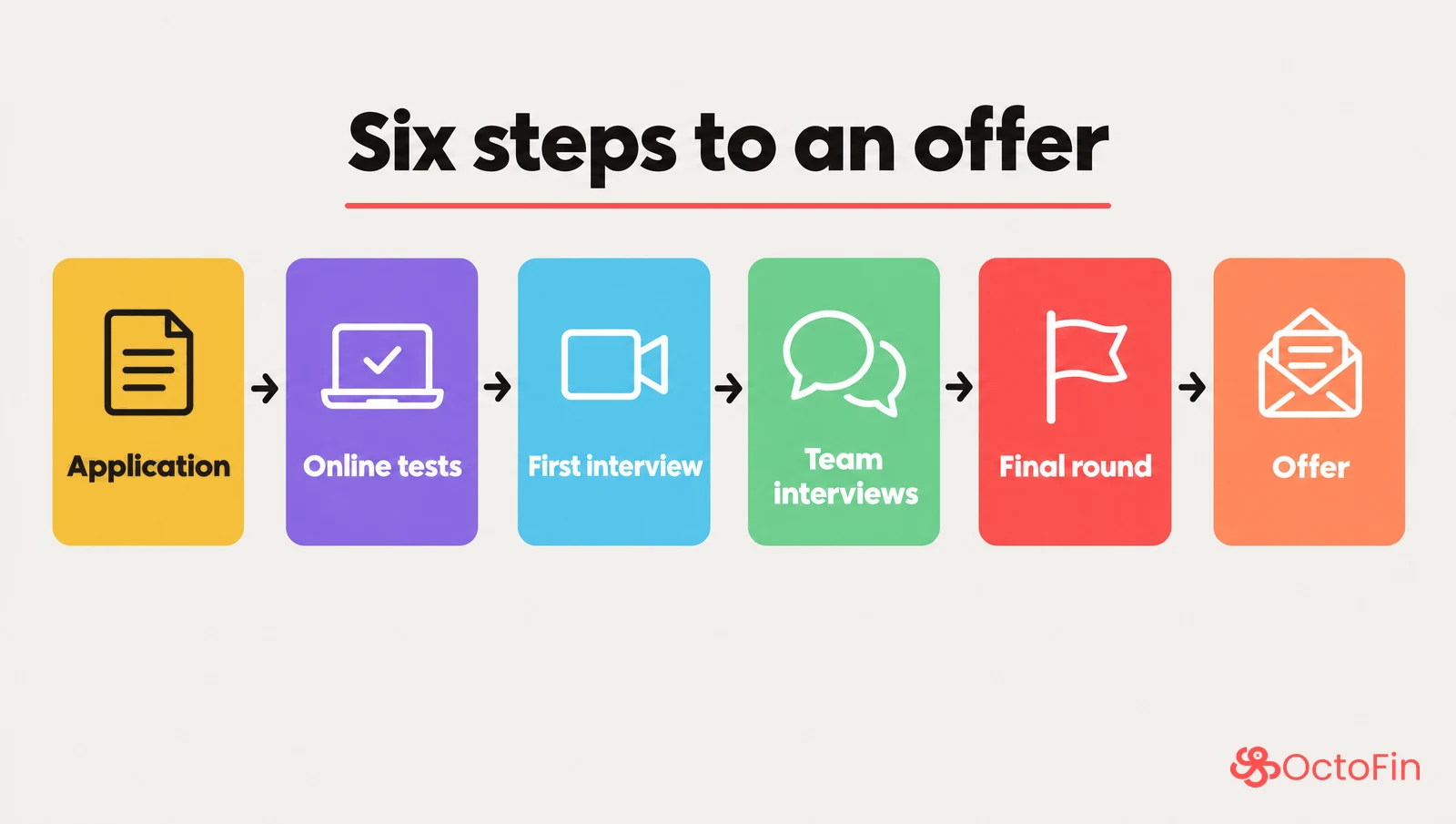
The order is the one most banks follow, not a rule: some skip the tests, others merge the first interview and the video, and a small boutique can run the whole process in a few conversations. When a bank describes its own steps in an offer, that description wins over any guide, this one included.
What 1,128 interview reports say about the rounds
OctoFin collects real interview reports written by candidates. On November 16, 2026, 42 firms (investment banks, advisory firms and a few funds) each had at least five reports, for 1,128 reports in all (reports on firms with fewer than five are left out, which is why this total is below the overall number of reports on OctoFin). Each report carries an interview type and a difficulty level. We only use these aggregated figures, never an individual report.
| Interview type | Reports | Share |
|---|---|---|
| Mixed (fit and technical in the same interview) | 759 | 759 / 1,128 ≈ 67% |
| Technical only | 198 | 198 / 1,128 ≈ 18% |
| Fit or motivation only | 113 | 113 / 1,128 ≈ 10% |
| Case study | 57 | 57 / 1,128 ≈ 5% |
| Other | 1 | 1 / 1,128 ≈ 0.1% |
| Total | 1,128 | 759 + 198 + 113 + 57 + 1 = 1,128 |
Three things stand out.
- Two interviews in three mix fit and technicals. Preparing "the fit interview" and "the technical interview" as two separate events is a mistake: in most rounds, you go from "walk me through your resume" to an accounting question in the same conversation.
- More than half the reports rate the interview moderate, not hard. 606 reports say moderate (606 / 1,128 ≈ 54%), 424 say difficult (424 / 1,128 ≈ 38%) and 98 say easy (98 / 1,128 ≈ 9%). These are the candidates' own ratings, given after the interview.
- The reports are mostly about off-cycle internships. 1,038 of the 1,128 reports are for off-cycle internships (1,038 / 1,128 ≈ 92%), against 39 for summer internships and 34 for full-time analyst roles. The reports don't record a city, but Mergers & Inquisitions describes the off-cycle internship at a big bank as "common in Europe but rare in the U.S.": these reports say more about the European process than about US summer recruiting. Keep that in mind when you read them.
Step 1: the application
It all starts with an online form: your resume, often a cover letter, and a few questions about your availability and your degree.
- Keep your resume to one page, results first. Morgan Stanley's interview advice starts with your resume: you should be able to talk about everything on it without reading it. Every line will become a question, so every line should show what you did.
- Read the rules before you click. Rothschild & Co accepts at most seven applications worldwide per recruitment cycle, and the two Paris offers read for this guide allow applications to up to three positions per calendar year. Once sent, its resume and cover letter can't be edited.
- Tailor the "why us". A generic cover letter or a copy-paste answer to "Why this bank?" is spotted immediately. Rothschild & Co's FAQ says it plainly: you may use AI to prepare, but your application must use your own words and reflect your own experience.
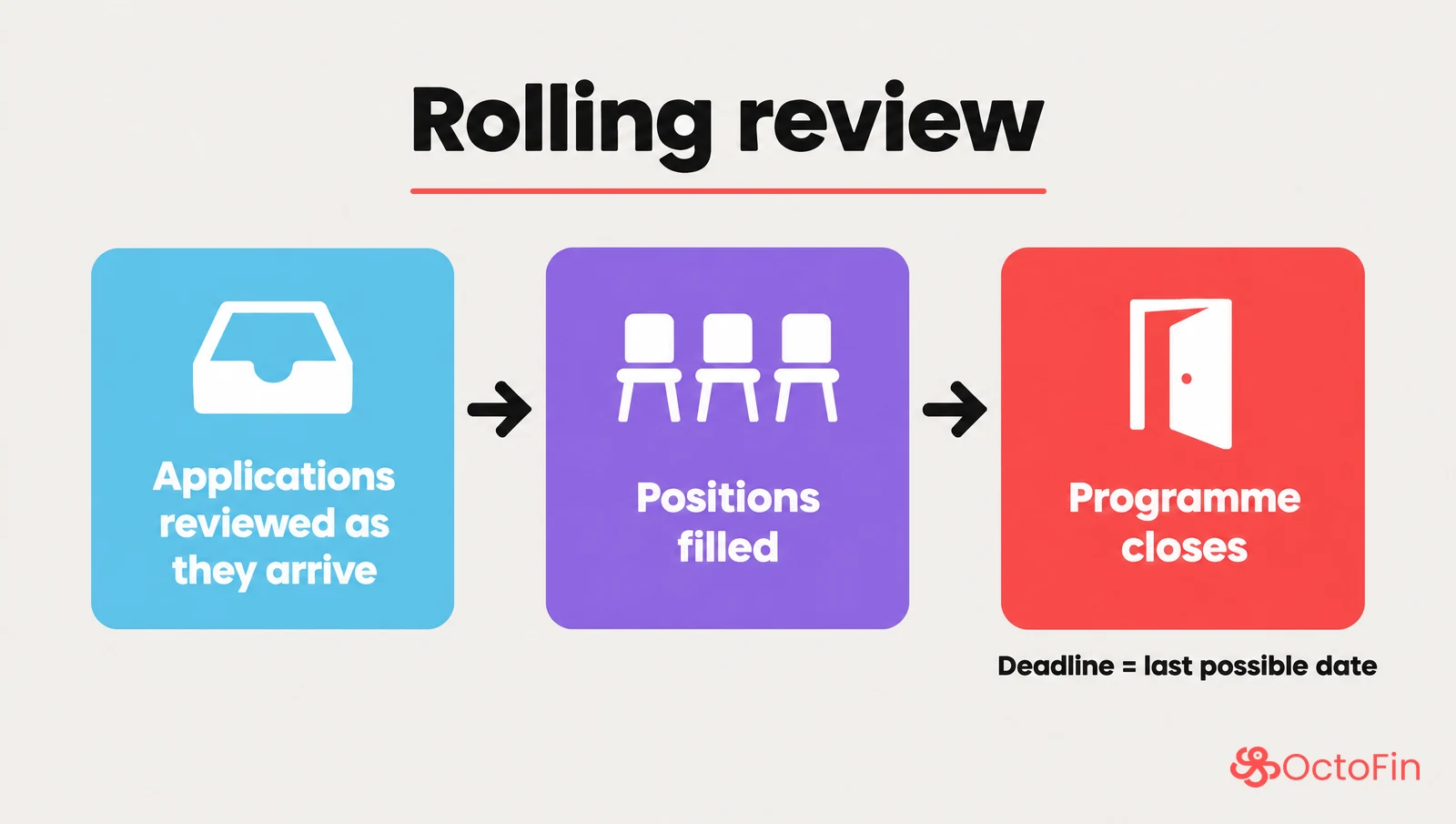
Many banks review applications as they come in, on a rolling basis. J.P. Morgan writes it in its Paris off-cycle offer and adds that its programmes close once positions are filled. Goldman Sachs evaluates applications "throughout the recruiting season", so you may hear back about different roles at different times. In London, Rothschild & Co goes further for its 2027 Summer Analyst Programme: applications opened on August 19, 2026, and it conducts interviews continuously from that date. In other words, the deadline is the last possible date, not the date to aim for.
If you target Paris, check one more thing before you apply: in France, every student internship requires an internship agreement (convention de stage) signed by you, the host company and your school, according to the government's Service Public website. Make sure your school can issue one for the dates in the offer. For the dates themselves, our M&A internship recruiting calendar lists each bank's openings and deadlines, and our guide to the off-cycle internship in investment banking explains the European format.
Step 2: online tests and the recorded video interview
If your application passes the first screen, you usually receive a link to online assessments, a recorded video interview, or both.
The online tests. In the UK and Europe, you have to complete online math, logic and verbal tests, along with written competency questions, according to Brian DeChesare's interview guide on Mergers & Inquisitions (updated in July 2024). Rothschild & Co's FAQ gives practical details for its own assessment:
- the link can take up to three working days to arrive after you apply;
- the assessment isn't timed, but there is a deadline, and no extensions;
- if you already took it for another application the same year, your results carry over;
- AI tools are not allowed during the assessment unless the bank says otherwise, and misuse can get your application withdrawn.
The recorded video interview. Questions appear on screen and you record your answers on camera, with no one on the other side. At J.P. Morgan, if you move to the next step, you receive an email invitation to a video interview "powered by HireVue", and your application isn't reviewed further until you complete it. Mergers & Inquisitions notes that HireVue questions tend to be very generic: your strengths and weaknesses, why this bank, why investment banking.
Treat these steps as real rounds, not formalities. Practice the format before the real thing, sit somewhere quiet, and for the video, check lighting, sound and framing as you would for a live interview. Prepare your answers to the classic motivation questions out loud: a recorded answer you have never said before sounds like it.
Step 3: the first interview
The first interview is a screen: a phone call with HR, a conversation with a junior banker, or, at Goldman Sachs, the video interview itself, which takes about 30 minutes according to the firm's careers page. At Blanche Capital, a Paris M&A boutique, the first step listed in its internship offer is a phone call with the HR team. Wall Street Prep's guide notes that the first round can be a phone interview, or an in-person interview if the bank comes to your campus.
The goal is simple: check that your profile holds up and that your motivation is real. Expect three things:
- Your story. "Tell me about yourself" or "Walk me through your resume". Mergers & Inquisitions recommends outlining a 200 to 300-word pitch: where you come from, why M&A, why now.
- Why this job, why this bank. Morgan Stanley asks candidates for a compelling reason to want to work in the industry, at the firm and in the division they're interviewing for.
- A few basic technical questions. The three financial statements, what an enterprise value is, how you'd value a company. Our investment banking interview questions give spoken answers to 28 classic questions, with the common mistakes.
This is also where an inconsistency on your resume shows. Every experience should be told in two sentences: what the team did, what you did, what you learned.
Step 4: interviews with the team
Next come one or more rounds with bankers at different levels, from analyst to director. In the reports shared on OctoFin, two interviews in three are mixed: interviewers rarely run a pure fit or a pure technical interview, and usually mix both in the same conversation.
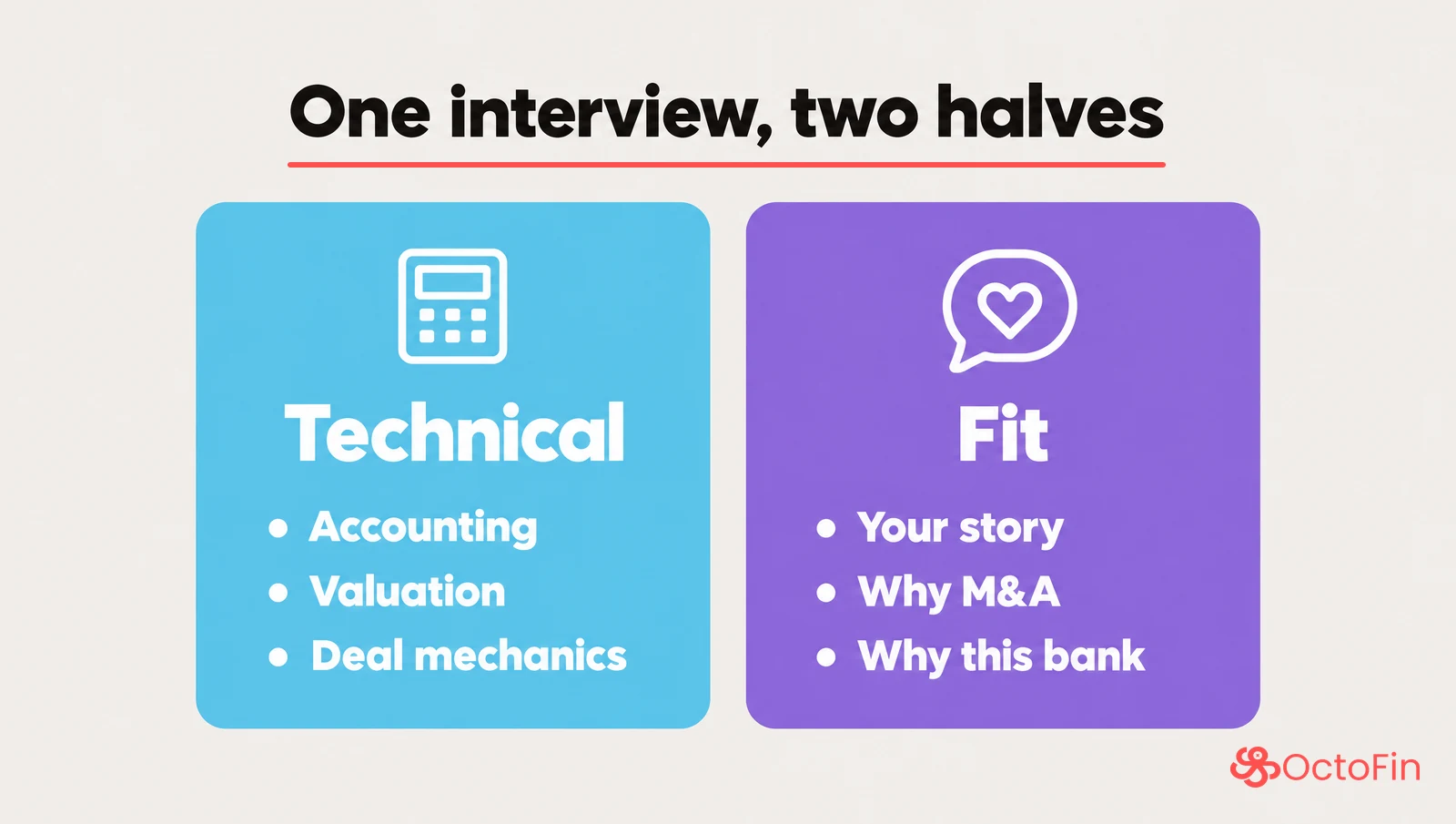
On the technical side, the same topics come up from one process to the next. Mergers & Inquisitions lists accounting, finance, valuation, and M&A and LBO modeling:
- accounting, above all the links between the income statement, the balance sheet and the cash flow statement;
- valuation: trading multiples, transaction multiples and the DCF, and what moves each one (our walk me through a DCF answer is built to be said out loud);
- deal mechanics: a merger, a debt-financed acquisition, and for some teams the LBO (practice with a paper LBO example, solved step by step);
- current events: a recent deal you can explain and give an opinion on, ideally in the team's sector.
On the fit side, Morgan Stanley says its interviews "could be competency, strengths based, skills based or technical", and that it doesn't always expect the right answer: it wants to see how you work through a scenario. Interviewers want to know whether you can keep up with the pace, work in a team and be put in front of a client. Mergers & Inquisitions suggests preparing three short stories that answer most fit questions. Your stories should be precise, structured, and about what you did.
Some teams add a case study or a technical test. Two Paris offers describe theirs:
- Blanche Capital: a case study and an interview with an analyst, two hours in all, then an interview with an associate and a current intern;
- Rothschild & Co's Sovereign Advisory team: two to three rounds of interviews, with a technical test in the first round.
If you want to see what the analysts who interview you actually do all day, our guide to the M&A analyst job walks through a sale process and a worked example of ranking buyer offers.
Step 5: the final round, superday or assessment centre
Most processes end with a final round of several interviews in a row. What it's called and what it contains depends on the city.
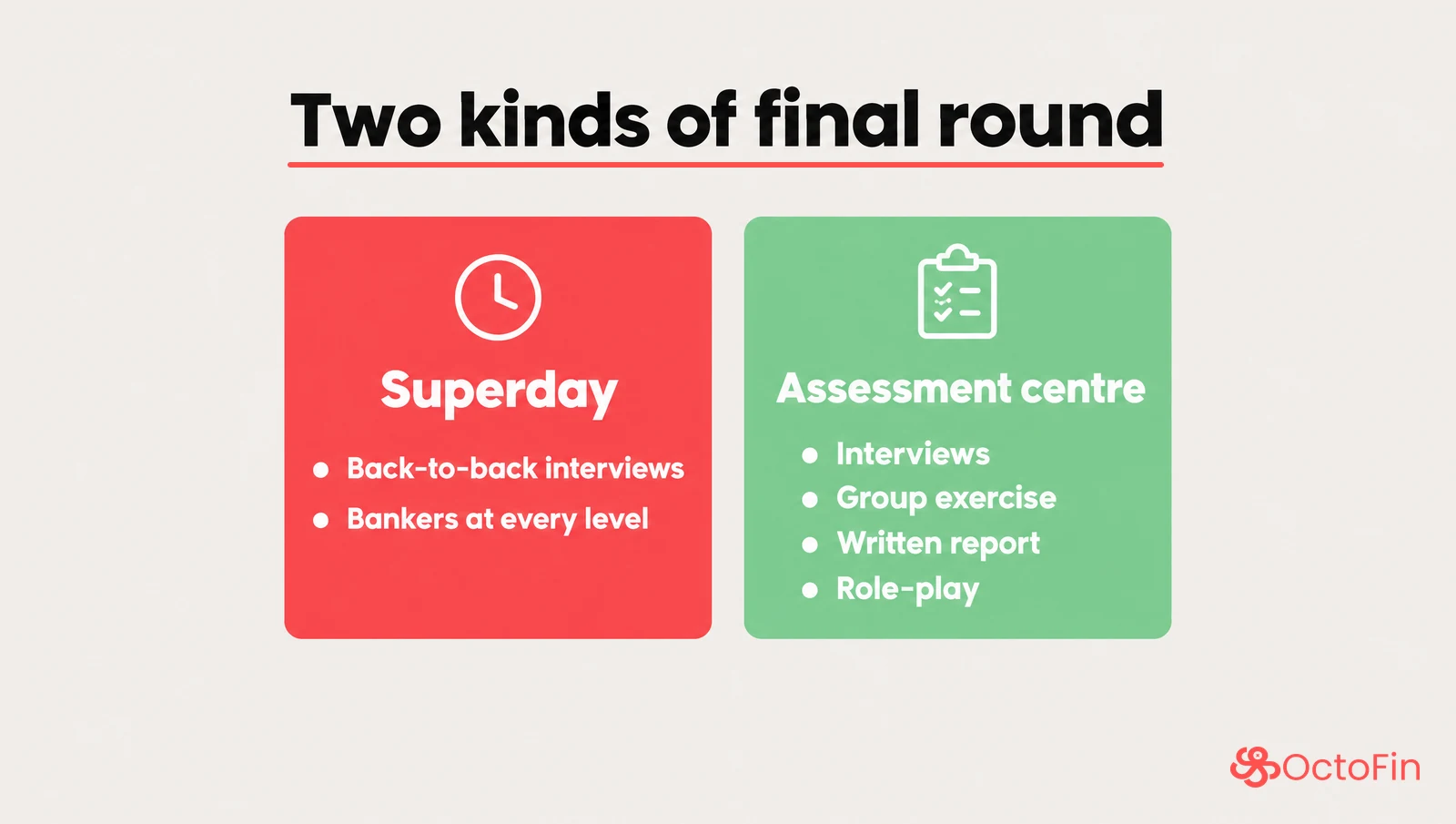
In North America, the final round is the superday: Mergers & Inquisitions describes it as a day at the bank's office where you interview in person with many bankers at all levels, from analyst to managing director. Goldman Sachs typically holds between two and five interviews for campus hires, depending on the division, with "a cross-section of people" you could work with. Wall Street Prep adds that these interviews are usually one-on-one or two-on-one, and that banks often hold a small dinner or networking event the night before, which you should treat as an interview.
In the UK and Europe, the superday is often replaced by an assessment centre. According to Mergers & Inquisitions, you complete exercises such as group presentations, report writing, role-playing and e-tray or in-tray (answering a simulated inbox) in addition to the standard interviews.
In Paris, some banks group interviews in a single morning: Rothschild & Co's offer for a Large Cap internship starting in July or September 2027, still online on November 16, 2026, announced a first set of interviews during a recruitment morning on November 13 or November 20, from 9 am to noon (the offer doesn't give the year). At Blanche Capital, the last step is a conversation with a partner.
The challenge lies less in each question than in the length of the day: you have to be as sharp and as enthusiastic in the last interview as in the first. Everyone you meet that day is assessing you, including at the dinner the night before when there is one. Between interviews, reset: the next banker hasn't heard your previous answers, so tell your story again in full.
Step 6: the offer
Mergers & Inquisitions puts it bluntly: if you get an offer, you hear back quickly; if not, the bank may say nothing or drag out the decision. Goldman Sachs commits to three messages per application: a confirmation shortly after you apply, a status update later in the season, and an answer at the end of the season.
If you need a visa, read the conditions early. Rothschild & Co's FAQ says visa sponsorship can be evaluated during the selection process but may not be possible for every role, and that an offer is subject to immigration approval before your start date.
This is the moment to ask your questions about dates, the team and the offer, and to let the other banks you're interviewing with know where you stand.
How the process differs in New York, London and Paris
| New York (analyst roles) | London | Paris | |
|---|---|---|---|
| Screening | HireVue or another recorded video, or a phone interview | Online math, logic and verbal tests, written competency questions | Varies by offer: HR call, video interview, technical test |
| Final round | Superday at the bank's office | Assessment centre: interviews plus group exercises | Rounds with the team, sometimes a recruitment morning |
| Source | Mergers & Inquisitions | Mergers & Inquisitions, Rothschild & Co | Bank offers (Rothschild & Co, Blanche Capital, J.P. Morgan), Service Public |
The Paris column is the least standardised: each offer describes its own steps, and the interview types in the reports shared on OctoFin vary just as much (see the table above). Mergers & Inquisitions also notes that candidates applying outside formal programmes, for example from a Big 4 firm, face a series of interviews over a long period with unpredictable timing.
What makes the difference, step by step
| Step | What is assessed | How to prepare |
|---|---|---|
| Application | A clear background, motivation | A one-page, results-driven resume, answers tailored to each bank, applying early |
| Online tests | Rigor, time management | Practice the format, recreate real conditions |
| Video interview | First impression, motivation | Say your story and your "why us" out loud before recording |
| First interview | A consistent profile | Be able to tell the story of every resume line in two sentences |
| Interviews with the team | Technical basics, fit | Review accounting and valuation, prepare three stories |
| Final round | Consistency, the ability to represent the bank | Keep your energy up, stay precise until the very end |
Frequently asked questions
How many rounds of interviews are there in investment banking?
It depends on the bank. Goldman Sachs describes a video interview followed by a superday of two to five interviews for campus hires; Rothschild & Co's Sovereign Advisory team announces two to three rounds of interviews in its offer; Blanche Capital lists four steps, from an HR call to a meeting with a partner. Count the online tests and the recorded video as rounds too: you can be stopped there.
What is a superday in investment banking?
A superday is the final round: a day of back-to-back interviews with several bankers, from analyst to managing director, usually at the bank's office. At Goldman Sachs, it means two to five interviews for campus hires, depending on the division. In London, the equivalent is often an assessment centre, which adds group exercises, report writing and role-play to the interviews.
How long does the investment banking recruiting process take?
There is no single figure: it depends on the bank, the city and the time of year. Goldman Sachs evaluates applications throughout the recruiting season and sends its final answer at the end of the season. In Paris, interviews can take place months before the start date: J.P. Morgan's Paris off-cycle offer, read on November 16, 2026, set November 6, 2026 as the application deadline for internships running from July to December 2027.
Do investment banks use HireVue?
Yes, several do. J.P. Morgan requires a HireVue video interview before reviewing an application further, and Goldman Sachs uses it as the first interview, for about 30 minutes. According to Mergers & Inquisitions, HireVue questions tend to be generic: strengths and weaknesses, why this bank, why investment banking.
Can I use AI during online assessments?
Not unless the bank says so. Rothschild & Co's FAQ allows AI to help you prepare, understand the role or structure your thoughts, but not during online assessments or interviews, and says misuse can lead to your application being withdrawn. Check each bank's rules before you start.
Keep practicing
At every step, the most useful thing is knowing how the process plays out at the bank you're targeting: how long the interviews last, the technical level expected, the questions that keep coming up. That's what the real interview reports on OctoFin describe, bank by bank: more than 1,300 of them. Alongside them, 11 chapters and 57 lessons cover accounting, valuation, the DCF and the M&A process, and more than 1,000 practice questions let you rehearse the technical half of every interview. Plans and pricing are on the home page: see pricing. OctoFin doesn't offer one-to-one coaching: for a mock superday with a banker, a human coach is the better fit.